I'm a day late in posting this, but for completeness feel I should write something. Yesterday's shift involved quite a lot of going in and out of lock. There were a few seismic spikes that may well have been caused by the wind, which had picked up considerably yesterday. This wind made the drive home a bit more fun as I had to battle against it a bit and avoid the tumbleweed flying across the road.
I've not really got anything more to say about the shift, so I'll just add that yesterday evening I watched an episode of Stargate Universe. I've not really watched any of the other Stargate franchise (well I've seen the original film, and caught the odd episode of the original series), but I thought this was very good. From what I've seen I think this is rather darker than the other Stargate spin-offs, and more in the mould of BSG. I don't think there will be many light and fun episodes, with rather more emphasis on lurching from one seemingly hopeless situation to another. Unfortunately I caught episode four (and most of episode five), so I think I'll be having to download the first three (which sort of form a three-part opening episode) when I get home. Robert Carlyle is very good in it too.
Saturday, October 24, 2009


Friday, October 23, 2009
SciMon Diary: Day 12
I've not been feeling too well today (I suspect a mild case of radiation poisoning), so I can't really be bothered writing anything. But to satisfy your LIGO cravings here's a LIGO dance:
Note how they form an L-shaped interferometer and the dancers act out the laser light (which is obviously what they intended). They try out a few different, and maybe slightly unconventional configurations though, but I think they throw in a Sagnac there too.
Note how they form an L-shaped interferometer and the dancers act out the laser light (which is obviously what they intended). They try out a few different, and maybe slightly unconventional configurations though, but I think they throw in a Sagnac there too.
Thursday, October 22, 2009
SciMon Diary: Day 11
Today the student became the master when I got to impart all my SciMon knowledge to a new trainee. Firstly I described the importance of waxing cars, sanding floors, and painting fences, and how they should practice that over and above all else - this bemused the trainee, who thought such things couldn't be applied to looking after a gravitational wave detector. They'll be thanking me when they enter the local SciMon tournament and those SciMons from the other detectors (I'm looking at you Livingston - the evil dojodetector) try dirty tricks to win.
Tuesday, October 20, 2009
SciMon Diary: Day 10
Like last Tuesday (and in fact every Tuesday) today has been a maintenance day at the detector, which means that we've not taken any science mode data and have been out of look for pretty much my entire shift. There's therefore not been much for me to look at detector-wise, so I've been busying myself with me regular work - this has mainly consisted of getting increasingly frustrated with the Frame Library (a set of software that creates, and reads, data in the format that we use for gravitational wave data). I have also attempted to make some inroads into writing my lecture for the SUPA course on gravitational waves (I've not got very far, but if you want a sneak preview of what it'll be like then I'll mainly be talking about stuff from this review article.)
I currently feel like I'm now coming down with a cold, which should make the next few days extra fun!
I currently feel like I'm now coming down with a cold, which should make the next few days extra fun!
SciMon Diary: Day 9
Not really much to say today, but I don't want to leave a gap in the diary, so here's my summary of my shift: some science mode; some non-science mode; some seismic noise; no big earthquakes (at least none during my shift - a 6.2 magnitude one in Samoa hit us just after my shift ended.)
To add a bit of spice to this entry I'll let you know what I get up to afterwork! I get home, go the gym, make dinner, watch TV with a couple of beers, go to bed. Sounds exciting doesn't it! I sometimes mix it up with a trip to the supermarket, and today had the great fun of doing some washing. This has been my social life for the last two weeks. I don't know how I'll cope and interact with people when I get back to Glasgow - it'll be sensory overload.
To add a bit of spice to this entry I'll let you know what I get up to afterwork! I get home, go the gym, make dinner, watch TV with a couple of beers, go to bed. Sounds exciting doesn't it! I sometimes mix it up with a trip to the supermarket, and today had the great fun of doing some washing. This has been my social life for the last two weeks. I don't know how I'll cope and interact with people when I get back to Glasgow - it'll be sensory overload.
Monday, October 19, 2009
SciMon Diary: Day 8 (week 2)
When I arrived at the detector we'd been in science mode for about 5 hours and that continued for another 7 hours of my shift - a nice 12 hours at a range of ~17 Mpc. I'd been hopeful that we'd stay in lock for the whole of my shift, which would have made things nice and easy, but unfortunately something happened. It did allow me to actually do something in trying to track down the source of the lock loss - it wasn't an obvious seismic event, and various accelerometers on on a variety of optical benches were inconclusive (I had a lot of help to show me what channels I should be looking to perform the diagnostics). By the end of my shift we had some clues, but still didn't know what the ultimate cause was, or whether the same thing had caused loss lock on other occasions. I had learned a fair bit more about the diagnostics software though, and the locations of a variety of optical benches.
Sunday, October 18, 2009
Day off
I started my day with a nice 2 hour 45 minute drive from Richland to the White Salmon river (Google maps was quite accurate in it's allotted trip time). As I said previously I was off to raft the river with these guys. I arrived about an hour early (seeing as I wasn't completely sure how long the drive would take, so I left quite a bit of leeway), so went and had a look at the river and the Husum falls - there were a few kayakers paddling about. I was the first to arrive, but soon after a large group of guys who'd be rafting with us turned up, followed (a bit late) by another local couple. The group were a bunch of guys (mainly from Seattle) who were out on a bachelor weekend - they'd had a big night in Portland the night before, but seemed quite perky and up for it (well the groom-to-be was looking a bit pale, but he made it through ok). Our river guides for the day were Todd (one of the co-founders of the company) and Drew - they kitted us out and then drove us up to the get in.
At the get in (a private get in further up the river than the standard commercial get in, that allowed us to do a load more rapids) we had a introduction to whitewater rafting - how to sit in the boat; how to paddle; what to do if you fall in, etc. We then got split into two groups - it was the bachelor party in one boat with Todd, and the couple (Darrell and Amanda) and me in the other with Drew. Once in the river we did a bit of practicing paddling forward, paddling backwards, and turning, and then got going - the couple had both rafted the river before, so I was the only beginner in the boat. As we had fewer people in our boat we were a bit more nimble and manoeuvrable than the other guys. The top half of the river was a succession of class III rapids and we survived them all and I got the hang a paddling on a raft (which is unsurprisingly quite different that being in a kayak, it being a big open rubbery-ring thing rather than a plastic thing that you're enclosed in). About halfway down we reached a bit where there was a class V fall, which we walked around. After the fall there was the opportunity to rejoin the rafts either by jumping of a ~20 ft drop into the very cold (it being glacial melt water filtered through basalt) water, or walking down. Me and four others choose the jumping option.
After that there were a few more nice rapids, but the main event of the trip was the final Husum falls - about a 10 ft drop that's apparently one of the larger commercially rafted falls in the US. Before reaching it we practiced what to do when we went over the fall - drop onto the floor of the raft and grab onto the available lines. We ran the fall quite easily, but got quite a soaking at the bottom.
It was a fun trip. The guides were really good guys and the other rafters were very nice. But, I have to say, I'd have far preferred to kayak the river. In the raft you actually don't get to do much - you hardly need to paddle - and as it's so big you don't get the proper feeling going through waves and off drops (it kind of smoothes everything out). I do think it would be fantastic to run in a kayak though. I would recommend rafting, but probably you'll enjoy it more if you've not kayaked any class III or higher stuff before. I would also highly recommend doing a trip with Wet Planet Whitewater too.
My drive back was quite tiring and I actually now ache far more from sitting in a car for nearly six hours than from the paddling.
At the get in (a private get in further up the river than the standard commercial get in, that allowed us to do a load more rapids) we had a introduction to whitewater rafting - how to sit in the boat; how to paddle; what to do if you fall in, etc. We then got split into two groups - it was the bachelor party in one boat with Todd, and the couple (Darrell and Amanda) and me in the other with Drew. Once in the river we did a bit of practicing paddling forward, paddling backwards, and turning, and then got going - the couple had both rafted the river before, so I was the only beginner in the boat. As we had fewer people in our boat we were a bit more nimble and manoeuvrable than the other guys. The top half of the river was a succession of class III rapids and we survived them all and I got the hang a paddling on a raft (which is unsurprisingly quite different that being in a kayak, it being a big open rubbery-ring thing rather than a plastic thing that you're enclosed in). About halfway down we reached a bit where there was a class V fall, which we walked around. After the fall there was the opportunity to rejoin the rafts either by jumping of a ~20 ft drop into the very cold (it being glacial melt water filtered through basalt) water, or walking down. Me and four others choose the jumping option.
After that there were a few more nice rapids, but the main event of the trip was the final Husum falls - about a 10 ft drop that's apparently one of the larger commercially rafted falls in the US. Before reaching it we practiced what to do when we went over the fall - drop onto the floor of the raft and grab onto the available lines. We ran the fall quite easily, but got quite a soaking at the bottom.
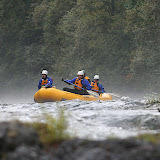 |
| Rafting the White Salmon river |
It was a fun trip. The guides were really good guys and the other rafters were very nice. But, I have to say, I'd have far preferred to kayak the river. In the raft you actually don't get to do much - you hardly need to paddle - and as it's so big you don't get the proper feeling going through waves and off drops (it kind of smoothes everything out). I do think it would be fantastic to run in a kayak though. I would recommend rafting, but probably you'll enjoy it more if you've not kayaked any class III or higher stuff before. I would also highly recommend doing a trip with Wet Planet Whitewater too.
My drive back was quite tiring and I actually now ache far more from sitting in a car for nearly six hours than from the paddling.
Saturday, October 17, 2009
SciMon Diary: Day 7
So I've reached the halfway point in my scheduled shifts - 7 down and 7 more to go. Today was generally seismically quieter than previous days (maybe the workmen just don't work as hard on a Friday!) and there were no major earthquakes, so we were able to maintain lock for longer and get a better range. We managed to keep in science mode for about half of the shift.
At the start of each shift I have to talk to the outgoing SciMon, look at the electronic logbook (elog) that's kept, and then write an entry detailing the detectors' performance during the shift. We have a variety of figures of merit (FOMs) that are displayed in the control room, examples of which include: a running plot of the range; the detectors state vector (i.e. whether we're in science mode or not); the average power in various frequency bands; the time to which, at the current sensitivity, we could reach the Crab pulsar's spin-down limit; different frequency bands from seismometers located at various parts of the detector (i.e. the central station, or the ends of the two arms of the interferometer); and the glitchiness of the detector. At the end of each shift plots of these FOMs are automatically posted on the elog, and the entry we write basically describes what's shown in the plots, but giving details of things like why we lost lock (which may not be directly obvious from the FOMs), glitches that occurred, and events in the seismic channels. These notes can then either inform the people who work on the detector about potential glitches in the detector system (that they can hopefully fix), or be used if an interesting event is seen in an astrophysical analysis to check that there's no other more mundane reason for the event. Anyway that was a long winded way of me getting round to saying that the automatically generated elog FOM plots were not actually generated before my shift (the script that runs them had accidentally not been restarted following a change), so I had to try and generate my own FOMs to describe what had gone on. I didn't do quite as professional a job with my amateur effort as in the standard plots, but I at least displayed the science segments and range for the previous eight hours.
We again had a school group in the control room today, and again their first questions seemed to be about the two clocks - what is it with school kids and clocks? Have they never seen them before?
My shift ended with us increasing the laser power from the 8W of normal weekday running to the 14W normally used at night and weekends. More power means more sensitivity (see this nice tutorial on laser shot noise for why), but it can also make the detector harder to control and easier to knock out of lock, so that's why the higher power is generally only used when it's seismically quieter. With this higher power we were managing ranges of over 16Mpc. Hopefully that'll continue over the weekend and when I go back in on Sunday we'll have lots of nice data.
Now I just have to prepare myself for tomorrow's rafting trip. Here's a preview of what I'll be doing:
At the start of each shift I have to talk to the outgoing SciMon, look at the electronic logbook (elog) that's kept, and then write an entry detailing the detectors' performance during the shift. We have a variety of figures of merit (FOMs) that are displayed in the control room, examples of which include: a running plot of the range; the detectors state vector (i.e. whether we're in science mode or not); the average power in various frequency bands; the time to which, at the current sensitivity, we could reach the Crab pulsar's spin-down limit; different frequency bands from seismometers located at various parts of the detector (i.e. the central station, or the ends of the two arms of the interferometer); and the glitchiness of the detector. At the end of each shift plots of these FOMs are automatically posted on the elog, and the entry we write basically describes what's shown in the plots, but giving details of things like why we lost lock (which may not be directly obvious from the FOMs), glitches that occurred, and events in the seismic channels. These notes can then either inform the people who work on the detector about potential glitches in the detector system (that they can hopefully fix), or be used if an interesting event is seen in an astrophysical analysis to check that there's no other more mundane reason for the event. Anyway that was a long winded way of me getting round to saying that the automatically generated elog FOM plots were not actually generated before my shift (the script that runs them had accidentally not been restarted following a change), so I had to try and generate my own FOMs to describe what had gone on. I didn't do quite as professional a job with my amateur effort as in the standard plots, but I at least displayed the science segments and range for the previous eight hours.
We again had a school group in the control room today, and again their first questions seemed to be about the two clocks - what is it with school kids and clocks? Have they never seen them before?
My shift ended with us increasing the laser power from the 8W of normal weekday running to the 14W normally used at night and weekends. More power means more sensitivity (see this nice tutorial on laser shot noise for why), but it can also make the detector harder to control and easier to knock out of lock, so that's why the higher power is generally only used when it's seismically quieter. With this higher power we were managing ranges of over 16Mpc. Hopefully that'll continue over the weekend and when I go back in on Sunday we'll have lots of nice data.
Now I just have to prepare myself for tomorrow's rafting trip. Here's a preview of what I'll be doing:
Friday, October 16, 2009
SciMon Diary: Day 6
There was a pleasant surprise this morning when I arrived at the detector. We were in lock, and the nasty noise I mentioned yesterday had gone (although there was still quite a lot of noise making the data below ~100Hz rather jumpy). This noise source caused there to be huge wings/sidebands on the 120Hz and 180Hz lines in the data (these lines are harmonics of the 60Hz line, which comes from the AC frequency of the US mains electricity). The noise seemed to have started when one of the optical benches (on which sits a variety of optics, like mirrors, beam splitters and such) was "landed" - it had previously been floated on a very thin layer of air. So, one of the things that was done yesterday was to re-float the bench. It looks like it was this that improved things, but it's not entirely conclusive (other things like slight realignments were performed). None of that happened during my shift, but it was nice to see the work payoff.
During the shift we were still troubled by the low frequency anthropogenic noise and we only stayed in lock for about half the shift, but that's better than yesterday (when there had been issues other than seismic noise keeping us from reacquiring lock).
We had some excitement in the control room when we were invaded by a large party of local school kids, but the seemed reasonably restrained and asked some questions about the various monitors in the control room (the group was split into two to visit the control room and both groups asked about the two big clocks we have, one of which shows the local time [PDT at the moment] and the other that shows UTC). While they were there I had some pieces of paper, with complicated looking maths on it, so hopefully I looked like a proper scientist to the students.
During the shift we were still troubled by the low frequency anthropogenic noise and we only stayed in lock for about half the shift, but that's better than yesterday (when there had been issues other than seismic noise keeping us from reacquiring lock).
We had some excitement in the control room when we were invaded by a large party of local school kids, but the seemed reasonably restrained and asked some questions about the various monitors in the control room (the group was split into two to visit the control room and both groups asked about the two big clocks we have, one of which shows the local time [PDT at the moment] and the other that shows UTC). While they were there I had some pieces of paper, with complicated looking maths on it, so hopefully I looked like a proper scientist to the students.
Thursday, October 15, 2009
SciMon Diary: Day 5
Another poor day for the detector. We weren't having maintenance day today, but we were out of lock for the whole of my shift. It's those pesky workmen again making a lot of noise in the 1-3Hz seismic band. This is the frequency range that relatively local anthropogenic activity generally manifests itself in, so we have a monitor which shows this to check how it correlates with our being in lock, or our inspiral range. Earthquakes generally show up in the 0.03-0.1Hz band and can also knock us out of lock, so we also monitor this (there was a magnitude 6 earthquake today off Samoa, which showed up as a large spike in this band, but as we were out of lock anyway it didn't hurt us).
Seeing as it wasn't looking like we'd get any science data it was decided that we'd let people go and play with the detector in the afternoon. One of the hopes was that we'd be able to track down a source of noise that kept our range down for the last couple of weeks (we should be able to regularly see out to over 16-17 Mpc at night, but we've been maxing out at around 14 Mpc). Hopefully when I go in tomorrow I'll be pleasantly surprised to see that we had an increased range overnight, but it may well be a complicated problem without a quick fix.
Today I also sorted out what I'm going to do on my day off this Saturday - I'll be going white water rafting on the White Salmon river with Wet Planet Whitewater. This should give me my paddling fix and also give me something more exciting to write about on Sunday.
Seeing as it wasn't looking like we'd get any science data it was decided that we'd let people go and play with the detector in the afternoon. One of the hopes was that we'd be able to track down a source of noise that kept our range down for the last couple of weeks (we should be able to regularly see out to over 16-17 Mpc at night, but we've been maxing out at around 14 Mpc). Hopefully when I go in tomorrow I'll be pleasantly surprised to see that we had an increased range overnight, but it may well be a complicated problem without a quick fix.
Today I also sorted out what I'm going to do on my day off this Saturday - I'll be going white water rafting on the White Salmon river with Wet Planet Whitewater. This should give me my paddling fix and also give me something more exciting to write about on Sunday.
Wednesday, October 14, 2009
SciMon Diary: Day 4
Here's my next eagerly anticipated instalment of exciting tales from the LIGO Hanford Observatory. So what fascinating antics did the detector get up to during my shift today? Well... nothing actually. For all my shift we stayed out of science mode and out of lock due to today being a scheduled maintenance day. During this time there was a big magnitude 6.3 earthquake off Alaska, which most likely would have knocked us out of lock had we been up. Many important things were done to the detector, but it did mean that I wasn't required for much.
One strange thing did happen during the shift though - it rained, and has continued raining for most of the day. It's been completely dry for the previous week, and generally this is a dry place (it is the high desert after all), so it was a nice change to see the familiar weather of back home.
In lunch news it seems that my Philadelphia was as I left it yesterday, and I also discovered a sandwich toaster (which I'd previously though was a George Forman grill), so I was able to have nice toasted bagels.
One strange thing did happen during the shift though - it rained, and has continued raining for most of the day. It's been completely dry for the previous week, and generally this is a dry place (it is the high desert after all), so it was a nice change to see the familiar weather of back home.
In lunch news it seems that my Philadelphia was as I left it yesterday, and I also discovered a sandwich toaster (which I'd previously though was a George Forman grill), so I was able to have nice toasted bagels.
Tuesday, October 13, 2009
SciMon Diary: Day 3
Today was a rather poor day for the detector. It wasn't behaving very well and refused to stay in lock. To be fair to it it wasn't entirely it's fault - there were some noisy workmen playing nearby (doing something to an irrigation canal apparently) and they kept disturbing it (we think). We only had short segments of good science data and even during those our range was quite low at about 12 Mpc.
A more disturbing occurrence was that I found that some of my Philadelphia, which I have placed in the fridge at the detector, was stolen! I'll see if this flagrant theft continues tomorrow.
A more disturbing occurrence was that I found that some of my Philadelphia, which I have placed in the fridge at the detector, was stolen! I'll see if this flagrant theft continues tomorrow.
Sunday, October 11, 2009
SciMon Diary: Day 2
For my shifts I have to get up at the previously unknown time of 6:40am - it's quite a hardship I can tell you. I bet no-one else has ever had to get out of bed so early to start a job! I then have a 20 min drive along some of the most boringly straight roads you have ever seen (luckily my car has cruise control otherwise I think my legs would just cramp up from the monotony).
At the start of today's shift I was given the folder containing the visitor rules and regulations, which I've had to read. There's a computer use policy in there and I'm not sure if writing this blog constitutes allowed use of the computing infrastructure - it's probably fine.
I learned a bit about how LIGO compensates for the fact that tidal forces stretch the detector arms. We pre-calculate the expected change and perform some thermal adjustments to compensate. However in reality this only corrects for about half the total effect, so we also have to apply some actuation to the end test masses. Our first loss of lock today was caused by one of the controls for these actuators reaching the end of it's allowed range and getting stuck.
I've been trying to teach myself how to use the LIGO DataViewer, which is one of the software tools that allows us to quickly look at the data from all the different channels that the detector produces (it outputs data channels that contain any gravitational wave signal, but it also has hundreds of auxiliary channel monitoring various states of the detector systems). With this I can look at a snapshot of data, have a real time feed, or trend past data, from all the channels available.
I also submitted this paper to The Astrophysical Journal.
In other exciting news today I decided to make my own lunch rather than buy one of the very poor quality sandwiches from the 7-eleven on the way in. I have some bagels and a large tub of Philadelphia, and muffins.
Come back tomorrow to see I can keep up this scintillating, and enthralling, diary.
At the start of today's shift I was given the folder containing the visitor rules and regulations, which I've had to read. There's a computer use policy in there and I'm not sure if writing this blog constitutes allowed use of the computing infrastructure - it's probably fine.
I learned a bit about how LIGO compensates for the fact that tidal forces stretch the detector arms. We pre-calculate the expected change and perform some thermal adjustments to compensate. However in reality this only corrects for about half the total effect, so we also have to apply some actuation to the end test masses. Our first loss of lock today was caused by one of the controls for these actuators reaching the end of it's allowed range and getting stuck.
I've been trying to teach myself how to use the LIGO DataViewer, which is one of the software tools that allows us to quickly look at the data from all the different channels that the detector produces (it outputs data channels that contain any gravitational wave signal, but it also has hundreds of auxiliary channel monitoring various states of the detector systems). With this I can look at a snapshot of data, have a real time feed, or trend past data, from all the channels available.

I also submitted this paper to The Astrophysical Journal.
In other exciting news today I decided to make my own lunch rather than buy one of the very poor quality sandwiches from the 7-eleven on the way in. I have some bagels and a large tub of Philadelphia, and muffins.
Come back tomorrow to see I can keep up this scintillating, and enthralling, diary.
SciMon Diary: Day 1
Today saw my first day as an expert SciMon - the first of thirteen more days. It being the weekend there weren't really many people at the site, in fact for the most part it was just me and the detector operator (someone who actually knows how to run the detector!). During the shift was based in the control room at the observatory, which looks like this, and has a variety of monitors projected onto the walls - some of the most useful monitors show the current estimated range (the distance, in Megaparsecs, out to which we could observe a binary neutron star coalescence), the sensitivity curve, and a variety of seismometer channels (useful for seeing if there's been an earthquake).
The main (but not only) duty of a SciMon is to document when and why the detector falls out of lock - being in lock means that the interference pattern that the detector uses to sense length changes isheld on held just off a dark fringe [I've updated this as I just got reminded that we no longer lock on the dark fringe, but instead use a system where we lock just off the dark fringe (a so-called DC readout) - this is to help us better control the detector] i.e. where the light from the two arms of the interferometer are almost completely cancelling each other out - during this state, and if the detector's behaving itself, it can be said to be in science mode and we can use that data for astrophysical analyses.
For the first half of my shift the detector was behaving itself nicely, and I thought we might make it through the whole 8 hours staying in science mode. But this hope was dashed when a reasonably local earthquake in Nevada knocked us out of lock. The disturbance from this lasted a while, but we got back into science mode and the end of my shift saw us back behaving well. There was also an unexpected interruption in the control room near the end of the run when a tour group came through to observe the detector in operation.
At the end of the shift I handed over to the next SciMon on the 4pm-12am shift, but I'll be back tomorrow. (Posts probably won't get much more exciting than this)

The main (but not only) duty of a SciMon is to document when and why the detector falls out of lock - being in lock means that the interference pattern that the detector uses to sense length changes is
For the first half of my shift the detector was behaving itself nicely, and I thought we might make it through the whole 8 hours staying in science mode. But this hope was dashed when a reasonably local earthquake in Nevada knocked us out of lock. The disturbance from this lasted a while, but we got back into science mode and the end of my shift saw us back behaving well. There was also an unexpected interruption in the control room near the end of the run when a tour group came through to observe the detector in operation.
At the end of the shift I handed over to the next SciMon on the 4pm-12am shift, but I'll be back tomorrow. (Posts probably won't get much more exciting than this)
Saturday, October 10, 2009
Trainee
On Monday I flew out to the US to start my time doing SciMon shifts (as I talked about here) at the LIGO Hanford Observatory (LHO). My first full day here (Tuesday) was not spent at the detector, but was mainly spent in bed overcoming jetlag (and also an illness I seemed to come down with during my flight - not pleasant). But for the last three days I have been out at the detector learning the trade of the SciMon as a trainee. There's been little for me to actually do, but having a computer has meant that I could just get on with my regular work. I have learned what a variety of the monitors that we have in our control room mean (it's a bit like a space mission control room, with banks of screens and computers), and I've seen the effect of the last weeks multiple strong earthquakes on the detector.
Tomorrow I start my first seven days in duty as the "expert" SciMon. After that I then have a day off followed by another seven days of shifts. I'm going to try and write something every day about my experience, so be prepared for 14, probably, fairly dull posts about my experience. I may be going slightly mad towards the end!
Tomorrow I start my first seven days in duty as the "expert" SciMon. After that I then have a day off followed by another seven days of shifts. I'm going to try and write something every day about my experience, so be prepared for 14, probably, fairly dull posts about my experience. I may be going slightly mad towards the end!
Friday, October 09, 2009
Back to the Clyde
In a late post that's just for the record (so I can keep track of what kayaking trips I've been on) I will briefly comment on the bit of paddling I did last Sunday. We had a beginners trip to the Clyde, where, according to this post, I apparently swam last time I did it. I not quite sure how, or where, I swam, because at the section we did it's a very tame river - useful for beginners trips to ease them in to things, but not too exciting for anyone else. I was still grateful to get on the trip as my last river paddling was a while ago and it's all good experience. In fact my general river skills, such as paddling out of eddys properly (eddying out) and paddling across a river (ferrying), aren't too good, so it was nice to practice these - even though I think some of the beginners showed me up a bit on both. The paddle was reasonably uneventful, although there were three swims from two of the new folk (but not me this time!). The beginners seemed to enjoy it and no-one got put off, so hopefully they'll all be back for more. I think I want to get back to rivers with bigger waves and more rapids, just because I don't look as stupid when trying to do simple river manoeuvres - going off weirs and waterfalls I can do!
Thursday, September 24, 2009
Interrail
In about two hours I board a train to take me from Budapest, where I've been attending our collaboration meeting, to Munich, where I'll be partaking in beer and sausage at Oktoberfest. Hopefully it'll be a nice journey with lots of pleasant scenery, but it does involve a 7 and a half hours on a train. If there's free wifi on the train (I have no idea whether this will be the case or not) I might give you a running commentary of the journey - or I might just catch up on sleep.
Wednesday, September 23, 2009
Limiting factors
Yesterday the search that I've spent most of the last two years performing went on arXiv (following on from the search described in this post). I'll reproduce the abstract here and then try and explain a bit more about it:
Firstly, if you follow the link to the paper, you might notice that there are actually 679 authors on this paper! That's quite a few more than you'll see on most astrophysics papers (by a couple of orders of magnitude!) and I'm somewhere in the middle of it. The reason for this is that the work has been done as part of the LIGO Scientific Collaboration (LSC) and the Virgo Collaboration, and everyone who has put work into designing, building, commissioning and running the detectors and analysis infrastructure (like code libraries, computing resources, theoretical understanding) that we use is included. We also have a few extra authors from outside these two collaborations. These are a selection of electromagnetic pulsar astronomers who have provided vital information about the sources we're looking for in gravitational waves. Here we've used data from the fifth science run (S5) of the LIGO gravitational wave detectors, which took place from Novmeber 2005 to October 2007, and during which the detectors were at their design sensitivity.
The aim of this search is to use already known astronomical objects - pulsars (neutron stars) - as targets from which to look for gravitational wave emission - these are probably the most promising targets within our own galaxy, although there are many exciting extra-galatic sources. These objects are very dense (about the mass of the sun compressed into a sphere about 20km across) and rapidly rotating (they spin round 100 times or more every second - i.e. the surface of the star is rotating at about 20 million km/hr, or 2% of the speed of light) - both of which make these potentially good sources of gravitational waves. It requires a bit more than just being massive and fast for these objects to emit gravitational waves - they have to have some sort of deformation making them triaxial (like a rubgy ball, but with the difference between the axes being far smaller at less than around a millimetre). Are they actually deformed at this level (or a larger or smaller amount)? Well that's something we want to find out by looking for gravitational waves from them. And if we do see something we can make constraints on the exact make-up of the material in the pulsars.
The reason to go after known pulsars (rather than neutron stars that aren't currently observed [which we are also doing, and you can help with]) is that it's relatively computationally easy. If you don't know where to look to find a source (in, say, sky position and frequency) then you literally have to look everywhere, which requires huge computational resources. Whereas, if you have a known object you know precisely where to look. So that's what we do. We take our gravitational wave detector data and look at the frequency of a particular pulsar and see if there's a signal sticking up above the noise floor at that spot (it's not quite as simple as that because our data is produced by a detector sitting on the Earth, which is a moving platform, so any signal hitting the detector will be Doppler shifted [i.e. the frequency will change slightly as we're travelling towards and away from the source] and we have to take this into account - luckily we know the position of the source and the speed and position of the Earth and can calculate this shift - and also the pulsar spins-down, so it's frequency changes as it loses energy [and some young pulsars have messy frequency evolutions due to still unknown effects]). This signal is parameterised by four physical quantities of the source - the gravitational wave amplitude (directly related to the size of deformity on the star), the initial phase of the signal, the inclination of the pulsar, and the polarisation angle - so we try and estimate these parameters from our data. Unfortunately in this search we saw no signals from any of the pulsars we looked at, so rather than being able to estimate these parameters we instead set an upper limit for each - a limit at which we say that, at a 95% degree-of-belief, the gravitational wave amplitude from the pulsar must be less than.
For this search our best upper limit on amplitude (i.e. the smallest value) is 2.3x10⁻²⁶ (or 0.000000000000000000000000023) for a pulsar called J1603-7202 (the name gives the sky position of the pulsar in right ascension α, and declination δ, so this pulsar is at α = 16h03m and δ = -72o02'). This value is obviously small, but it's a dimensionless quantity called strain, so what does it actually mean physically. Well given our detectors are 4km long (well two of them were 4km and one was 2km) it means that the signal from this pulsar cannot be changing the length of the detector by more that 2.3x10-26 x 4000m = 9.2x10⁻²³ metres (or 0.000000000000000000000092 metres, or, in the favourite units of human hair widths, its about 1 billion billionth of a hhw). If you look at the displacement sensitivity of the detectors then, at their best, between about 100-200 Hz, they would seem to show that they can reach 1x10-19 m Hz-1/2 - which is four orders of magnitude worse than our result! However, that value has the funny units of m Hz-1/2, which is displacement spectral density - if we have a continuous signal that we can track over long time periods (like a known pulsars) we can get better sensitivity than this by integrating over time (basically just using long observations), which allows us to dig into the amplitude spectral density noise floor by the square root of the observation time (is seconds) - hence our better limits.
We can use our amplitude upper limit to set a limit on the ellipticity of the pulsar (basically the size of the deformation) - this requires us to assume that we know the star's moment of inertia (which in fact could be uncertain by up to a factor of three depending on the mass and make-up of the star i.e. it's equation of state), and that we accurately know the star's distance (which are generally uncertain by 10-20%, but could be uncertain by a factor of 2-3!). However, plugging in standard numbers for these values, our best upper limit on the ellipticity for any of the pulsars in our search was 7.0x10⁻⁸ for J2124-3358. Given that the star has a diameter of about 20km this would mean that any deformations on it are less that about 1.5mm i.e. our direct observations rule out hills on this star, which is hundreds of light years away, being larger than 1.5mm!
Is an upper limit by itself interesting? Well that depends on your previous ideas about the source. If you think that the source could, or should, be emitting gravitational waves at a level above your upper limit then you can infer new information. In our case, for each pulsar, we have something called the "spin-down upper limit", which says that if we assume that all the kinetic energy that the pulsar loses as it spins-down is being radiated as gravitational waves then we can calculate a limit on the amplitude of those waves. We can compare our direct observational upper limits with these spin-down limits, and if we beat them we're entering a new regime of knowledge about the pulsar. The majority of our pulsars are actually spinning down rather slowly (the fast, millisecond, pulsars are generally slowly spinning down, thought to be due to them having weak magnetic fields) so their spin-down limits are small and therefore our results are still well above them (by about 10-100 times). But for a few pulsars (generally younger pulsars) we approach, and in the case of the Crab pulsar (and if you assume larger moments of inertia also for J0537-6910) beat, this spin-down limit. So, we're in a regime where we potentially could see gravitational waves from the Crab pulsar. However if we look at the ellipticity we can estimate for it, given our measured upper limit, we get a value of around 1x10⁻⁴. Normal neutron star equations of state would suggest that the largest possible ellipticities that could be sustained by the star would likely be at least an order of magnitude (probably more) less than this, so you have to go to more exotic, and probably less likely, equations of state (things like quark stars) to get potential ellipticities at this level. Unfortunately these values are maximum possible deformations that the star might have, they could just be far smoother. For the Crab pulsar even though we've not seen a gravitational wave signal it's still nice to think about what this results means - in terms of the fraction of the star's energy it is losing when it spins-down, we can now say that less than 2% of it is being emitted via gravitational waves (magnetic dipole radiation and powering the accelerating expansion of the Crab nebula seem to dominate the energy loss).
These searches are not stopping because we've not seen anything yet. New data is currently being taken, which will soon hopefully surpass the S5 run in its sensitivity. We also have data from the Virgo detector, which will allow us to look for pulsars at lower frequencies than are accessible than LIGO - this is a frequency range where there are quite a few young rapidly spinning-down pulsars, which we hope to be able to surpass the spin-down limit for. New pulsars are also being discovered all the time (Fermi is has observed several new pulsars in γ-rays) and hopefully one of these could be a large gravitational wave emitter. We've only really just started these searches, so there's still a lot more to do and a detection could be just around the corner.
Searches for gravitational waves from known pulsars with S5 LIGO data
We present a search for gravitational waves from 116 known millisecond and young pulsars using data from the fifth science run of the LIGO detectors. For this search ephemerides overlapping the run period were obtained for all pulsars using radio and X-ray observations. We demonstrate an updated search method that allows for small uncertainties in the pulsar phase parameters to be included in the search. We report no signal detection from any of the targets and therefore interpret our results as upper limits on the gravitational wave signal strength. Our best (lowest) upper limit on gravitational wave amplitude is 2.3x10⁻²⁶ for J1603-7202 and our best (lowest) limit on the inferred pulsar ellipticity is 7.0x10⁻⁸ for J2124-3358. Of the recycled millisecond pulsars several of the measured upper limits are only about an order of magnitude above their spin-down limits. For the young pulsars J1913+1011 and J1952+3252 we are only a factor of a few above the spin-down limit, and for the X-ray pulsar J0537-6910 we reach the spin-down limit under the assumption that any gravitational wave signal from it stays phase locked to the X-ray pulses over timing glitches. We also present updated limits on gravitational radiation from the Crab pulsar, where the measured limit is now a factor of seven below the spin-down limit. This limits the power radiated via gravitational waves to be less than ~2% of the available spin-down power.
Firstly, if you follow the link to the paper, you might notice that there are actually 679 authors on this paper! That's quite a few more than you'll see on most astrophysics papers (by a couple of orders of magnitude!) and I'm somewhere in the middle of it. The reason for this is that the work has been done as part of the LIGO Scientific Collaboration (LSC) and the Virgo Collaboration, and everyone who has put work into designing, building, commissioning and running the detectors and analysis infrastructure (like code libraries, computing resources, theoretical understanding) that we use is included. We also have a few extra authors from outside these two collaborations. These are a selection of electromagnetic pulsar astronomers who have provided vital information about the sources we're looking for in gravitational waves. Here we've used data from the fifth science run (S5) of the LIGO gravitational wave detectors, which took place from Novmeber 2005 to October 2007, and during which the detectors were at their design sensitivity.

The aim of this search is to use already known astronomical objects - pulsars (neutron stars) - as targets from which to look for gravitational wave emission - these are probably the most promising targets within our own galaxy, although there are many exciting extra-galatic sources. These objects are very dense (about the mass of the sun compressed into a sphere about 20km across) and rapidly rotating (they spin round 100 times or more every second - i.e. the surface of the star is rotating at about 20 million km/hr, or 2% of the speed of light) - both of which make these potentially good sources of gravitational waves. It requires a bit more than just being massive and fast for these objects to emit gravitational waves - they have to have some sort of deformation making them triaxial (like a rubgy ball, but with the difference between the axes being far smaller at less than around a millimetre). Are they actually deformed at this level (or a larger or smaller amount)? Well that's something we want to find out by looking for gravitational waves from them. And if we do see something we can make constraints on the exact make-up of the material in the pulsars.
The reason to go after known pulsars (rather than neutron stars that aren't currently observed [which we are also doing, and you can help with]) is that it's relatively computationally easy. If you don't know where to look to find a source (in, say, sky position and frequency) then you literally have to look everywhere, which requires huge computational resources. Whereas, if you have a known object you know precisely where to look. So that's what we do. We take our gravitational wave detector data and look at the frequency of a particular pulsar and see if there's a signal sticking up above the noise floor at that spot (it's not quite as simple as that because our data is produced by a detector sitting on the Earth, which is a moving platform, so any signal hitting the detector will be Doppler shifted [i.e. the frequency will change slightly as we're travelling towards and away from the source] and we have to take this into account - luckily we know the position of the source and the speed and position of the Earth and can calculate this shift - and also the pulsar spins-down, so it's frequency changes as it loses energy [and some young pulsars have messy frequency evolutions due to still unknown effects]). This signal is parameterised by four physical quantities of the source - the gravitational wave amplitude (directly related to the size of deformity on the star), the initial phase of the signal, the inclination of the pulsar, and the polarisation angle - so we try and estimate these parameters from our data. Unfortunately in this search we saw no signals from any of the pulsars we looked at, so rather than being able to estimate these parameters we instead set an upper limit for each - a limit at which we say that, at a 95% degree-of-belief, the gravitational wave amplitude from the pulsar must be less than.
For this search our best upper limit on amplitude (i.e. the smallest value) is 2.3x10⁻²⁶ (or 0.000000000000000000000000023) for a pulsar called J1603-7202 (the name gives the sky position of the pulsar in right ascension α, and declination δ, so this pulsar is at α = 16h03m and δ = -72o02'). This value is obviously small, but it's a dimensionless quantity called strain, so what does it actually mean physically. Well given our detectors are 4km long (well two of them were 4km and one was 2km) it means that the signal from this pulsar cannot be changing the length of the detector by more that 2.3x10-26 x 4000m = 9.2x10⁻²³ metres (or 0.000000000000000000000092 metres, or, in the favourite units of human hair widths, its about 1 billion billionth of a hhw). If you look at the displacement sensitivity of the detectors then, at their best, between about 100-200 Hz, they would seem to show that they can reach 1x10-19 m Hz-1/2 - which is four orders of magnitude worse than our result! However, that value has the funny units of m Hz-1/2, which is displacement spectral density - if we have a continuous signal that we can track over long time periods (like a known pulsars) we can get better sensitivity than this by integrating over time (basically just using long observations), which allows us to dig into the amplitude spectral density noise floor by the square root of the observation time (is seconds) - hence our better limits.
We can use our amplitude upper limit to set a limit on the ellipticity of the pulsar (basically the size of the deformation) - this requires us to assume that we know the star's moment of inertia (which in fact could be uncertain by up to a factor of three depending on the mass and make-up of the star i.e. it's equation of state), and that we accurately know the star's distance (which are generally uncertain by 10-20%, but could be uncertain by a factor of 2-3!). However, plugging in standard numbers for these values, our best upper limit on the ellipticity for any of the pulsars in our search was 7.0x10⁻⁸ for J2124-3358. Given that the star has a diameter of about 20km this would mean that any deformations on it are less that about 1.5mm i.e. our direct observations rule out hills on this star, which is hundreds of light years away, being larger than 1.5mm!
Is an upper limit by itself interesting? Well that depends on your previous ideas about the source. If you think that the source could, or should, be emitting gravitational waves at a level above your upper limit then you can infer new information. In our case, for each pulsar, we have something called the "spin-down upper limit", which says that if we assume that all the kinetic energy that the pulsar loses as it spins-down is being radiated as gravitational waves then we can calculate a limit on the amplitude of those waves. We can compare our direct observational upper limits with these spin-down limits, and if we beat them we're entering a new regime of knowledge about the pulsar. The majority of our pulsars are actually spinning down rather slowly (the fast, millisecond, pulsars are generally slowly spinning down, thought to be due to them having weak magnetic fields) so their spin-down limits are small and therefore our results are still well above them (by about 10-100 times). But for a few pulsars (generally younger pulsars) we approach, and in the case of the Crab pulsar (and if you assume larger moments of inertia also for J0537-6910) beat, this spin-down limit. So, we're in a regime where we potentially could see gravitational waves from the Crab pulsar. However if we look at the ellipticity we can estimate for it, given our measured upper limit, we get a value of around 1x10⁻⁴. Normal neutron star equations of state would suggest that the largest possible ellipticities that could be sustained by the star would likely be at least an order of magnitude (probably more) less than this, so you have to go to more exotic, and probably less likely, equations of state (things like quark stars) to get potential ellipticities at this level. Unfortunately these values are maximum possible deformations that the star might have, they could just be far smoother. For the Crab pulsar even though we've not seen a gravitational wave signal it's still nice to think about what this results means - in terms of the fraction of the star's energy it is losing when it spins-down, we can now say that less than 2% of it is being emitted via gravitational waves (magnetic dipole radiation and powering the accelerating expansion of the Crab nebula seem to dominate the energy loss).
These searches are not stopping because we've not seen anything yet. New data is currently being taken, which will soon hopefully surpass the S5 run in its sensitivity. We also have data from the Virgo detector, which will allow us to look for pulsars at lower frequencies than are accessible than LIGO - this is a frequency range where there are quite a few young rapidly spinning-down pulsars, which we hope to be able to surpass the spin-down limit for. New pulsars are also being discovered all the time (Fermi is has observed several new pulsars in γ-rays) and hopefully one of these could be a large gravitational wave emitter. We've only really just started these searches, so there's still a lot more to do and a detection could be just around the corner.
Monday, September 07, 2009
Jury duty
Last week I was called upon to do my civic duty and go on jury service. I was in the Sheriff Court for the Sheriffdom of Glasgow and Strathkelvin, which deals with intermediate offences (and also some civil cases) - in fact prior to going into court (and in fact reading the wikipedia article I just linked to) I had no real idea of how the Scottish court system worked. One thing that the Sheriff court didn't have was a man with a star-shaped badge, a cowboy hat and leather chaps.
Having been cited to jury duty for Monday I didn't actually have to go into court until the Wednesday (I just had a number to call every evening to see if I was needed the next day). Glasgow Sheriff Court building was a big Orwellian block - quite cool architecturally, but very much like some kind of Ministry of Truth. On getting in there and going through security I discovered a quite ominous sign in the toilets stating that you needed to be careful when taking a paper towel as syringes have been found next to them before. After that I went up to my assigned courtroom where I discovered loads of people milling about - these turned out to all be jurors. There were some delays, so we all waited around outside the until we were lead into the courtroom, which was one of the smaller ones in the court. There were around sixty of us (which surprised me as I didn't expect anywhere near that number) and to fit into the courtroom some of the jurors had to sit in the dock and in the jury box (I got to sit in the jury box). We were then given a talk from the Clerk of Court about the court (apparently the largest and busiest court in Europe - not necessarily a claim to be proud of!), the role of the jury, and what would happen. Essentially what happens is the Sheriff, Prosecutor and Defence come in, followed by the defendant, the defendant give his plea (generally not guilty) and then the jury gets balloted from the group of people there. The balloting is very low-tech consisting of everyone's names getting put into a bowl, then 15 being picked out by the clerk and the jurors walking into the jury box. There was a case straight away once we'd been processed, so we got to see this in action. There was frisson of excitement as the names got read out - kind of like a weird bingo - but my number and name didn't appear (although the number before mine did).
After the jury was picked they had to be sworn in. When we'd been talked to by the clerk earlier he'd asked if we were picked whether we'd want to affirm rather than take the regular oath. Basically the standard thing is to take an oath swearing to God (I assume a Christian God, but maybe they're open to your own choice of divine being!) that you'll tell the truth, whereas the affirmation is a non-religious version. From those chosen jurors only two out of the fifteen chose to affirm. The oathers got to all take the oath together which required them standing, raising their right hands, and then saying "I do" after the oath had been read out by the clerk. The juror's affirming had to both do so individually and had to recite the whole thing, which was something of a tongue twister. I think it's about time that the oath is non-religious, i.e. doesn't require you to swear on any particular deity, by default.
After this all of us un-used jurors were asked to leave (although we could have stayed, as all the courts are open to the public [for nosey people I expect]), but return to another court after lunch in case we were needed as spares. Turning up at the court later on there were already about another sixty potential jurors waiting outside, so us extras were asked to leave and call back later. That was actually it for my time on jury duty as I never got called back again. I did get to sit in the jury box briefly, but never got to dole out justice to the criminal classes of Glasgow. At least this didn't happen.
Having been cited to jury duty for Monday I didn't actually have to go into court until the Wednesday (I just had a number to call every evening to see if I was needed the next day). Glasgow Sheriff Court building was a big Orwellian block - quite cool architecturally, but very much like some kind of Ministry of Truth. On getting in there and going through security I discovered a quite ominous sign in the toilets stating that you needed to be careful when taking a paper towel as syringes have been found next to them before. After that I went up to my assigned courtroom where I discovered loads of people milling about - these turned out to all be jurors. There were some delays, so we all waited around outside the until we were lead into the courtroom, which was one of the smaller ones in the court. There were around sixty of us (which surprised me as I didn't expect anywhere near that number) and to fit into the courtroom some of the jurors had to sit in the dock and in the jury box (I got to sit in the jury box). We were then given a talk from the Clerk of Court about the court (apparently the largest and busiest court in Europe - not necessarily a claim to be proud of!), the role of the jury, and what would happen. Essentially what happens is the Sheriff, Prosecutor and Defence come in, followed by the defendant, the defendant give his plea (generally not guilty) and then the jury gets balloted from the group of people there. The balloting is very low-tech consisting of everyone's names getting put into a bowl, then 15 being picked out by the clerk and the jurors walking into the jury box. There was a case straight away once we'd been processed, so we got to see this in action. There was frisson of excitement as the names got read out - kind of like a weird bingo - but my number and name didn't appear (although the number before mine did).
After the jury was picked they had to be sworn in. When we'd been talked to by the clerk earlier he'd asked if we were picked whether we'd want to affirm rather than take the regular oath. Basically the standard thing is to take an oath swearing to God (I assume a Christian God, but maybe they're open to your own choice of divine being!) that you'll tell the truth, whereas the affirmation is a non-religious version. From those chosen jurors only two out of the fifteen chose to affirm. The oathers got to all take the oath together which required them standing, raising their right hands, and then saying "I do" after the oath had been read out by the clerk. The juror's affirming had to both do so individually and had to recite the whole thing, which was something of a tongue twister. I think it's about time that the oath is non-religious, i.e. doesn't require you to swear on any particular deity, by default.
After this all of us un-used jurors were asked to leave (although we could have stayed, as all the courts are open to the public [for nosey people I expect]), but return to another court after lunch in case we were needed as spares. Turning up at the court later on there were already about another sixty potential jurors waiting outside, so us extras were asked to leave and call back later. That was actually it for my time on jury duty as I never got called back again. I did get to sit in the jury box briefly, but never got to dole out justice to the criminal classes of Glasgow. At least this didn't happen.
Monday, August 31, 2009
Wallabies and wake
Yesterday saw my first kayaking trip since the Etive weekend in May. We only had a few people out and had to make do with a flat water paddle on Loch Lomond. This was my second time out on the loch, although this time starting out from Luss on the west side, rather than near Balmaha on the east side. It was a fairly sedate paddle as the loch was calm and the only thing really disturbing it was the wake from the many boats and jet skis that were out there as well. Our main destination that we paddled out to was Wallaby Island where we went exploring to see the soon-to-be-culled Wallabies - we managed to see at least 3 individuals. It should be noted (unsurprisingly) that kayaking gear is not the best clothing to go scrambling round an island in - you get a bit too hot. On returning to our get in point we played around a bit practicing deep water rescues and rolling - being able to roll in a river boat (rather than the polo boats we use in the pool), with a buoyancy aid and helmet on, and in cold water is something that's useful when it comes to going down a river. It wasn't the most exciting of paddles, but it was good to get a bit of practice in again before things kick off properly with the new university term starting in two weeks.
Youtube sensation
Every summer the LIGO Lab at Caltech takes on a load of undergraduate SURF students to do research. This year some of those students have put together (for outreach purposes I think) a medley of various California-based songs with a re-worked gravitational wave/LIGO theme.
.
It's a fun video, but also quite excruciatingly embarrassing to watch.
.
It's a fun video, but also quite excruciatingly embarrassing to watch.
Sunday, August 23, 2009
We urned it!
I'm mainly writing this post so I could use that lovely pun as a title, but well done to the England Cricket team for taking back the Ashes. We just have to try and go over there and win it some time! As ever there ends my expert cricket analysis.
Edinburgh festival highlights
Last Sunday (my birthday!) and Wednesday I had trips through to Edinburgh to take in some comedy. Last year I didn't get to see anything in Edinburgh as I was in Germany (my trip through two years ago is detailed here), and March's Glasgow Comedy Festival didn't have much that appealed (I think the only thing saw was Richard Herring's Headmasters Son), so it had been a while since I'd seen any stand-up.
On the Sunday we had one show booked, which was Stewart Lee's If you prefer a milder comedian, please ask for one playing at the Stand. But, we'd gone through earlier in the day to try and find something else to see. After a while of sitting around by the Udderbelly (in Bristo Square) and managing to come to no decision as to what to see, we decided we might have better luck at the Pleasance. As at every venue we were approached by many enthusiastic flierers, but nothing particularly tempted us until a very polite young English man (probably fresh from completing his A-levels) convinced us to go and see Two episodes of Mash (by this point we really just wanted to see anything). It was a decent sketch-based set that has some very funny moments, and in general kept up a good pace - the show, at just under an hour, went by pretty quickly and there weren't any times when it seemed to lag (I'd say the two stars that Chortle gave it in the last link was a tad unfair). After that it was pretty much time to get up to the Stand. The Stand in Edinburgh is a cosy venue (slightly smaller and a quite different layout to the one in Glasgow) a we were sat right up front - pretty much on Stewart Lee's lap. It was a very good show (I'm sure Stewart Lee would rate my ability to craft a review up there with the works of Dan Brown). I was actually a bit surprised at the pace of the jokes - Lee can often spend ages on a sentence or two, but it was a lot faster than I expected (there was still his standard repetition of key themes, but not so long seemed to be taken over them) - this was probably due to the fact that he had a lot to cram in in the one hour set. His stuff about a certain pear cider advert is particularly good, as is his surprising song at the end (the guitar on stage for the whole set was reasonably confusing up until the very end).
On Wednesday we decided to take a day off work and again head over to Edinburgh. We mainly, somewhat unintentionally, were stalking Richard Herring for the day. First off was a trip to the Underbelly (in an extremely hot cave-like venue) to see a live recording of the Collings and Herrin Podcast - they were doing five consecutive days of live podcasts and we went to the first day. They've done three live podcasts previously and I've generally not found them to be as good as the regular podcast, but I really enjoyed this one - maybe being in the audience helped! After that, at the behest of Herring, there was a lunch outing to the Tempting Tattie for one of their tasty, and good value, baked potatoes (there weren't as many of us as at yesterdays gathering).
After that we went down to the half price ticket hut to try and look for a random show before the two pre-booked shows we were seeing in the evening. We settled on going to see Jason Cook with his show Fear. For a mid-afternoon show on a Wednesday it was rather surprisingly sold out, but this could maybe be explained by the good reviews the show has been getting. And it was a nice show by a very likeable comedian. The premise of the show - peoples fears - kind of disappeared about halfway through, but that wasn't really to the detriment of the performance. Cook did leave the audience very intrigued though, by mentioning the three months he spent in a maximum security prison in Libya on charges of piracy (it would have been interesting to hear more, but apparently it would induce a panic attack in Cook if he thought about it too much).
The next show was back seeing Herring again for his show Hitler Moustache. This was again in another roasting venue in the Underbelly. As someone who follows Herring's work via his blog and the podcasts I'd read/heard the inception and growth of the vast majority of the stuff in the show, so there wasn't really anything that came as a surprise. It was still a good show, and well polished, but I think I'd slightly self-spoilered it (I did have the thrill of seeing my name in the program though).
The final show of the night was a midnight performance by Daniel Kitson (who I've seen several times before) at the Stand (which as it happened Andrew Collins and Richard Herring were also at). We were again down the front right by the stage. Kitson has been the comedian against who I gauge all others as he's been unswervingly excellent whenever I've seen him. He was again very good, but my enjoyment was slightly dampened by a couple of things. The heat of the venue (a recurring theme it seems) and the time and length of the gig meant I was rather too tired, and flagged a lot for the last half hour or so of the our hour forty minute performance. I think the show could do with cutting down a bit (that said I've seen Kitson do a three hours set that was really good for the whole thing!), but I may have found it better if it had been at an earlier time, or I'd not had such a long day.
That's probably my fill of stand-up for a bit, but expect I'll see some more come next March's Glasgow Comedy Festival.
On the Sunday we had one show booked, which was Stewart Lee's If you prefer a milder comedian, please ask for one playing at the Stand. But, we'd gone through earlier in the day to try and find something else to see. After a while of sitting around by the Udderbelly (in Bristo Square) and managing to come to no decision as to what to see, we decided we might have better luck at the Pleasance. As at every venue we were approached by many enthusiastic flierers, but nothing particularly tempted us until a very polite young English man (probably fresh from completing his A-levels) convinced us to go and see Two episodes of Mash (by this point we really just wanted to see anything). It was a decent sketch-based set that has some very funny moments, and in general kept up a good pace - the show, at just under an hour, went by pretty quickly and there weren't any times when it seemed to lag (I'd say the two stars that Chortle gave it in the last link was a tad unfair). After that it was pretty much time to get up to the Stand. The Stand in Edinburgh is a cosy venue (slightly smaller and a quite different layout to the one in Glasgow) a we were sat right up front - pretty much on Stewart Lee's lap. It was a very good show (I'm sure Stewart Lee would rate my ability to craft a review up there with the works of Dan Brown). I was actually a bit surprised at the pace of the jokes - Lee can often spend ages on a sentence or two, but it was a lot faster than I expected (there was still his standard repetition of key themes, but not so long seemed to be taken over them) - this was probably due to the fact that he had a lot to cram in in the one hour set. His stuff about a certain pear cider advert is particularly good, as is his surprising song at the end (the guitar on stage for the whole set was reasonably confusing up until the very end).
On Wednesday we decided to take a day off work and again head over to Edinburgh. We mainly, somewhat unintentionally, were stalking Richard Herring for the day. First off was a trip to the Underbelly (in an extremely hot cave-like venue) to see a live recording of the Collings and Herrin Podcast - they were doing five consecutive days of live podcasts and we went to the first day. They've done three live podcasts previously and I've generally not found them to be as good as the regular podcast, but I really enjoyed this one - maybe being in the audience helped! After that, at the behest of Herring, there was a lunch outing to the Tempting Tattie for one of their tasty, and good value, baked potatoes (there weren't as many of us as at yesterdays gathering).
After that we went down to the half price ticket hut to try and look for a random show before the two pre-booked shows we were seeing in the evening. We settled on going to see Jason Cook with his show Fear. For a mid-afternoon show on a Wednesday it was rather surprisingly sold out, but this could maybe be explained by the good reviews the show has been getting. And it was a nice show by a very likeable comedian. The premise of the show - peoples fears - kind of disappeared about halfway through, but that wasn't really to the detriment of the performance. Cook did leave the audience very intrigued though, by mentioning the three months he spent in a maximum security prison in Libya on charges of piracy (it would have been interesting to hear more, but apparently it would induce a panic attack in Cook if he thought about it too much).
The next show was back seeing Herring again for his show Hitler Moustache. This was again in another roasting venue in the Underbelly. As someone who follows Herring's work via his blog and the podcasts I'd read/heard the inception and growth of the vast majority of the stuff in the show, so there wasn't really anything that came as a surprise. It was still a good show, and well polished, but I think I'd slightly self-spoilered it (I did have the thrill of seeing my name in the program though).
The final show of the night was a midnight performance by Daniel Kitson (who I've seen several times before) at the Stand (which as it happened Andrew Collins and Richard Herring were also at). We were again down the front right by the stage. Kitson has been the comedian against who I gauge all others as he's been unswervingly excellent whenever I've seen him. He was again very good, but my enjoyment was slightly dampened by a couple of things. The heat of the venue (a recurring theme it seems) and the time and length of the gig meant I was rather too tired, and flagged a lot for the last half hour or so of the our hour forty minute performance. I think the show could do with cutting down a bit (that said I've seen Kitson do a three hours set that was really good for the whole thing!), but I may have found it better if it had been at an earlier time, or I'd not had such a long day.
That's probably my fill of stand-up for a bit, but expect I'll see some more come next March's Glasgow Comedy Festival.
Monday, August 10, 2009
Installing chrome
[Update: there is now an easier, more hassle free, way to install Chrome, which can be found here.]
This post comes to you courtesy of the web browser Google Chrome. In fact so did the last post, but that was from my Mac laptop, whereas this is from my office desktop which runs Ubuntu. Installing this development version of Chrome has been a bit more trouble on my office machine than on my Mac, so I thought I'd document how I did it. The first thing to do is to download the .deb package from here (I've got the version for 32-bit systems) - this is a development version, so be warned that it could be buggy. This should then be relatively easy to install, i.e. I should just be able to type: dpkg -i google-chrome-unstable_current_i386.deb and away it goes, but unfortunately it defaults to trying to create, and then install stuff into, the /opt/google directory and for me, even with sudo, I can't write to that directory as it's not local to my machine - I get an error stating:
However, much searching has led me to find a solution to this (mainly from this page) that enabled me to install chrome in the directory of my choosing. Here's how it goes:-
Say you've downloaded the above .deb file to ~/Desktop, then create a directory to unpack it into:
Next you want to figure out where to install Chrome (i.e. somewhere that your permissions allow you to write to). I, for example, created a directory called /data/matthew/chrome. cd into that directory and then run
You can now also use flash with the development version of Chrome (as shown here), so it's all working pretty nicely now! [But, hey, Flash "...who uses that"!]
This post comes to you courtesy of the web browser Google Chrome. In fact so did the last post, but that was from my Mac laptop, whereas this is from my office desktop which runs Ubuntu. Installing this development version of Chrome has been a bit more trouble on my office machine than on my Mac, so I thought I'd document how I did it. The first thing to do is to download the .deb package from here (I've got the version for 32-bit systems) - this is a development version, so be warned that it could be buggy. This should then be relatively easy to install, i.e. I should just be able to type: dpkg -i google-chrome-unstable_current_i386.deb and away it goes, but unfortunately it defaults to trying to create, and then install stuff into, the /opt/google directory and for me, even with sudo, I can't write to that directory as it's not local to my machine - I get an error stating:
dpkg: error processing google-chrome-unstable_current_i386.deb (--install):
error creating directory `./opt/google': No such file or directory
Errors were encountered while processing:
google-chrome-unstable_current_i386.deb
However, much searching has led me to find a solution to this (mainly from this page) that enabled me to install chrome in the directory of my choosing. Here's how it goes:-
Say you've downloaded the above .deb file to ~/Desktop, then create a directory to unpack it into:
mkdir ~/Desktop/chrome; cd ~/Desktop/chromethen unpack the .deb file
ar -x ~/Desktop/google-chrome-unstable_current_i386.debNow uncompress the lzma file
lzma -d data.tar.lzma
Next you want to figure out where to install Chrome (i.e. somewhere that your permissions allow you to write to). I, for example, created a directory called /data/matthew/chrome. cd into that directory and then run
sudo tar xf ~/Desktop/chrome/data.tar(If you're just writing to somewhere that your normal permissions allow you to write to then you don't even have to run sudo.) This will add opt, etc and usr directories to the directory you are in, with the main stuff for Chrome being in opt/google/chrome. I can therefore run Chrome with the command
/data/matthew/chrome/opt/google/chrome/google-chrome.You can then just remove all the files you downloaded in ~/Desktop.
You can now also use flash with the development version of Chrome (as shown here), so it's all working pretty nicely now! [But, hey, Flash "...who uses that"!]
Sunday, August 09, 2009
Highlands and Islands
Yesterday saw only my second trip to a Scottish island (the other being the now legendary trip to Gigha) - this is a rather paltry number of islands for having lived in Scotland for seven years. The new island I went to was Arran, which is one of the closest and most accesible from Glasgow.
To get there you can take the CalMac ferry from Ardrossan. We got the first train from Glasgow to Ardrossan that supposedly connected up with the 9.45am ferry. However, on arrival we found a massive queue that meant there was no chance of getting on the ferry we'd planned. There were at least 300 slightly annoyed people left with us at the ferry terminal, at which we weren't allowed to use the waiting room, and so had to brave the elements outside. Because there was a Highland Games in Brodick (one of the main villages on Arran) there were a few extra ferries on, so we waited for the 11.30am crossing. Again this was filled before we made it on (in fact it was mainly filled with pre-booked car passengers, so hardly anyone from the queue got on). After this we had to make the decision as to whether to bother waiting for the 12.30 crossing (it was to be the big 600 seater ferry) and thought that given we'd already waited 2 hours we may as well sit it out for another hour. We did however get given a boarding card for the ferry that we were told would guarantee us a place on it, and were allowed to actually wait inside in the waiting room (in which, for some reason, they'd decided to not open their cafe despite apparently being their busiest day of the year). When the ferry arrived everyone rushed to get on, but we thought we'd let the queue diminish a bit before we attempted boarding, safe in the knowledge that we had our "guaranteed" boarding card. However, on getting to the gang plank the CalMac employee who had guaranteed our place on the ship and told us we could go off and wait inside decided he'd refuse us boarding and told us we should have been there earlier (we'd been waiting for 3 hours by then, so I don't think we could really have been any earlier!). We started arguing our case and fortunately the guy from on the boat decided to let us on. Needless to say the first few hours of our trip did not give me a good impression of CalMac, especially as while we were queueing we were given no information about what was going on and just had to rely on hearsay and chinese whispers from other, equally irate, people in the queue.
Anyway, we did eventually make it out to Brodick by about 1.30pm. Our main plan was to climb Goat Fell and this is exactly what we did. We walked passed the Highland Games site, most of which had taken part in the morning and we'd therefore missed. The base of Goat Fell (and Brodick) was alternatively sunny and overcast, but the summit was completely hidden in a cloud, which we hoped would clear by the time we reached it. It didn't clear. Due to the cloud we had no idea of how far it would be to the top (our visibility was about 20-30m, which enabled us to see the path, but not much else), but had many false dawns when we thought we spotted the peak only to find it to be nothing of the sort. We passed one group who were on the way down and asked them how much further it would be and they looked quite dejected and said it just kept going on and on - I didn't believe them, but they proved to be right. Despite this it was still a fun climb though and we made the top in just over two hours - there was obviously no view! They way down was a less dispiriting experience, but was quite harsh on the legs and knees. It only took about an hour and a half to get down and it was glorious to get out of the cloud and see Brodick harbour again.
The other plan we had, being on Arran, was to have some Arran Blonde beer. We didn't want to miss our only chance of a ferry home (the last one being at 7.15pm), so instead of heading straight to the pub we dragged ourselves, on tired legs, to the ferry terminal to check on the length of the queue. It wasn't too large, so we risked a brief trip to the pub. Around this time there were a few pipe bands marching down the main street who'd been there for the games. After our pint we went back to the ferry terminal where all the pipe bands had gathered and were playing for the queueing crowds. Now I don't mind the odd lone piper, but I didn't find that the pipe bands sounded very pleasant. That's maybe just because I'm English, or it could be just that the pipe bands I heard weren't very good, or were drunk (I think a lot of the pipers had been drinking most of the day), but really it wasn't something that could be listened to for any great length of time - unfortunately we did have to listen to it for a considerable length of time as they all boarded the ferry and continued playing (there are also only so many times you can hear Scotland the Brave and Flower of Scotland!)
As we crossed the sea and made it back to Ardrossan the sun came out and everything looked lovely. It was good to get out for the day and was a fun walk, but I hope my next trip to an island goes slightly more smoothly.
To get there you can take the CalMac ferry from Ardrossan. We got the first train from Glasgow to Ardrossan that supposedly connected up with the 9.45am ferry. However, on arrival we found a massive queue that meant there was no chance of getting on the ferry we'd planned. There were at least 300 slightly annoyed people left with us at the ferry terminal, at which we weren't allowed to use the waiting room, and so had to brave the elements outside. Because there was a Highland Games in Brodick (one of the main villages on Arran) there were a few extra ferries on, so we waited for the 11.30am crossing. Again this was filled before we made it on (in fact it was mainly filled with pre-booked car passengers, so hardly anyone from the queue got on). After this we had to make the decision as to whether to bother waiting for the 12.30 crossing (it was to be the big 600 seater ferry) and thought that given we'd already waited 2 hours we may as well sit it out for another hour. We did however get given a boarding card for the ferry that we were told would guarantee us a place on it, and were allowed to actually wait inside in the waiting room (in which, for some reason, they'd decided to not open their cafe despite apparently being their busiest day of the year). When the ferry arrived everyone rushed to get on, but we thought we'd let the queue diminish a bit before we attempted boarding, safe in the knowledge that we had our "guaranteed" boarding card. However, on getting to the gang plank the CalMac employee who had guaranteed our place on the ship and told us we could go off and wait inside decided he'd refuse us boarding and told us we should have been there earlier (we'd been waiting for 3 hours by then, so I don't think we could really have been any earlier!). We started arguing our case and fortunately the guy from on the boat decided to let us on. Needless to say the first few hours of our trip did not give me a good impression of CalMac, especially as while we were queueing we were given no information about what was going on and just had to rely on hearsay and chinese whispers from other, equally irate, people in the queue.
Anyway, we did eventually make it out to Brodick by about 1.30pm. Our main plan was to climb Goat Fell and this is exactly what we did. We walked passed the Highland Games site, most of which had taken part in the morning and we'd therefore missed. The base of Goat Fell (and Brodick) was alternatively sunny and overcast, but the summit was completely hidden in a cloud, which we hoped would clear by the time we reached it. It didn't clear. Due to the cloud we had no idea of how far it would be to the top (our visibility was about 20-30m, which enabled us to see the path, but not much else), but had many false dawns when we thought we spotted the peak only to find it to be nothing of the sort. We passed one group who were on the way down and asked them how much further it would be and they looked quite dejected and said it just kept going on and on - I didn't believe them, but they proved to be right. Despite this it was still a fun climb though and we made the top in just over two hours - there was obviously no view! They way down was a less dispiriting experience, but was quite harsh on the legs and knees. It only took about an hour and a half to get down and it was glorious to get out of the cloud and see Brodick harbour again.
The other plan we had, being on Arran, was to have some Arran Blonde beer. We didn't want to miss our only chance of a ferry home (the last one being at 7.15pm), so instead of heading straight to the pub we dragged ourselves, on tired legs, to the ferry terminal to check on the length of the queue. It wasn't too large, so we risked a brief trip to the pub. Around this time there were a few pipe bands marching down the main street who'd been there for the games. After our pint we went back to the ferry terminal where all the pipe bands had gathered and were playing for the queueing crowds. Now I don't mind the odd lone piper, but I didn't find that the pipe bands sounded very pleasant. That's maybe just because I'm English, or it could be just that the pipe bands I heard weren't very good, or were drunk (I think a lot of the pipers had been drinking most of the day), but really it wasn't something that could be listened to for any great length of time - unfortunately we did have to listen to it for a considerable length of time as they all boarded the ferry and continued playing (there are also only so many times you can hear Scotland the Brave and Flower of Scotland!)
As we crossed the sea and made it back to Ardrossan the sun came out and everything looked lovely. It was good to get out for the day and was a fun walk, but I hope my next trip to an island goes slightly more smoothly.
Sunday, July 26, 2009
Science monitor
A few days ago (despite being on holiday) I had to join a three hour conference call. The reason for this was to train me up to be a SciMon (I think it stands for Science Monitor). Very soon the LIGO detectors will be starting their sixth science run (a period when we stop, to an extent, fiddling with the detectors to improve them, and take data for astrophysical analysis) and during these periods we need people to be monitoring them. The detectors have full time staff who are trained to operate them, but during science runs we also have a scientist there to monitor, and comment on, the state of the data that's coming out i.e. if the data gets noisier, or glitchy, can you see a reason for it (an earthquake for example). These things can be fed back to the operators to see if they can improve things in the detector, and they are also very useful when analysing the data to know the time of good, or bad, data quality.
In previous runs I've haven't taken the SciMon role, but this time I volunteered to go out for a couple of weeks. So in October I'm going to be spending time at the LIGO Hanford Observatory. During the conference call I actually learnt quite a lot about the detectors that I only vaguely knew before, so I think being at the detector will be a valuable learning experience. I also found out that SciMons have a lot to do during the 8 hours shifts that you take (the detectors require 24 hour monitoring, so there's a midnight-8am, 8am-4pm and 4pm-midnight set of shifts - I managed to get the most reasonable middle time slot). It should be interesting being out there and I expect I'll write a few posts about the experience (there's a few months to go yet though).
In previous runs I've haven't taken the SciMon role, but this time I volunteered to go out for a couple of weeks. So in October I'm going to be spending time at the LIGO Hanford Observatory. During the conference call I actually learnt quite a lot about the detectors that I only vaguely knew before, so I think being at the detector will be a valuable learning experience. I also found out that SciMons have a lot to do during the 8 hours shifts that you take (the detectors require 24 hour monitoring, so there's a midnight-8am, 8am-4pm and 4pm-midnight set of shifts - I managed to get the most reasonable middle time slot). It should be interesting being out there and I expect I'll write a few posts about the experience (there's a few months to go yet though).
Small world
For the last week I've been down south visiting friends and family. As is normal I've been into London a few times to meet up with various friends. In the past when wandering round London I've spotted the occasional celebrity, but this time has been a bit weirder. On walking through Trafalgar Square (to see the plinth-based art installation One and Other) I passed one of my neighbours from Glasgow! She didn't seem to notice me, but it was definitely her. Strangely this isn't actually the first time I've bumped into someone I know from Glasgow randomly in London, but the last time it happened was with someone who was originally from London anyway and it was around Christmas (so wasn't quite as odd for him to be there).
It's not just folks from Glasgow that I've been randomly bumping into though. Just heading down the Strand yesterday I noticed a couple of old university friends, so had a chat with them. Later, on the train back from London to St Albans, I got off and realised that the girl in front of me was another old university friend (she definitely wasn't from St Albans, so I'm not sure what she was doing there).
It's not just folks from Glasgow that I've been randomly bumping into though. Just heading down the Strand yesterday I noticed a couple of old university friends, so had a chat with them. Later, on the train back from London to St Albans, I got off and realised that the girl in front of me was another old university friend (she definitely wasn't from St Albans, so I'm not sure what she was doing there).
Friday, June 26, 2009
Football on Riverside
Following an impromptu game of nighttime beach football at the GWDAW meeting earlier in the year, it was decided that there should be a more organised (and daylight) match at Amaldi. A group of 16 of us, made up from Europeans (a large chunk of whom were Italian, although unlike at GWDAW we didn't play Italians versus the Rest of the World), bar a couple of Antipodeans, went down to Riverside Park, in which we'd noted that google maps showed a football pitch-like shape. The shape we'd seen turned out to be a big astroturf pitch, which had a couple of baseball games going on in the corners and a football match in the middle. We tried squeezing in, but soon got informed by the coach (or some official-looking guy) of one the baseball games that we were supposed to have a permit to play there.
After some milling around and discussion of what to do we found a nearby patch of park ground that wasn't covered in trees (or fences designed to discourage ball games, which were quite liberally scattered around the most open of spaces) that would make a serviceable pitch. It had quite a slope on one side and was pretty uneven, but we made do. The game took a little while to get going and most people were showing signs of general lack of fitness, but towards the end (of our arbitrarily designated match time) we had a reasonable, and competitive, match going on. It was at 3-3, so we had a next goal wins situation, which through some brilliant touches of skill I scored.
I could definitely feel the effects of the match the next day as my left knee was suffering.
After some milling around and discussion of what to do we found a nearby patch of park ground that wasn't covered in trees (or fences designed to discourage ball games, which were quite liberally scattered around the most open of spaces) that would make a serviceable pitch. It had quite a slope on one side and was pretty uneven, but we made do. The game took a little while to get going and most people were showing signs of general lack of fitness, but towards the end (of our arbitrarily designated match time) we had a reasonable, and competitive, match going on. It was at 3-3, so we had a next goal wins situation, which through some brilliant touches of skill I scored.
I could definitely feel the effects of the match the next day as my left knee was suffering.
Intergalactic planetary
As with all major meeting's this one had a conference dinner - it was, rather impressively, held in the American Museum of Natural History. The highlight of the night was getting to go into the planetarium there and being shown a fly through of their very nice software for visualising the universe (well, we didn't fly through their software in the sense of having code projected onto the Planetarium ceiling and scrolling through it - we saw pretty pictures). The software tries to make as much use as possible of real astronomical data sets, so it doesn't project up artists impressions, or simulations (other than it's representation of the Milky Way as observed from outside), but tries to be a close to reality as allowable from current knowledge. All the data went together pretty seamlessly (they said that there are a few bugs to iron out, but it worked surprisingly well for a beta version - we were in essence getting a sneak peak that the generally lay-public won't get to see quite yet), from the visualisation of the Earth and it's satellites (after having zoomed out from a view of Manhattan) all the way out to the 2dF and SDSS galaxy and quasar surveys. One thing we got to do in the planetarium that you don't normally get to do (in big museum-style planetariums at least), was to lie on the floor in the middle and look up - it's a cool way to view it and saves you from getting a crick in your neck. Being able to observe the 2dF and Tully (a big space cube) surveys in 3D was cool, and looking down the 2 degree field beams was a way I'd never seen it before.
Apparently all the software that they use will be freely available at some point, but I forget who's developing it and where it lives. I think it's partially based on this Digital Universe package.
Apparently all the software that they use will be freely available at some point, but I forget who's developing it and where it lives. I think it's partially based on this Digital Universe package.
Edoardo's get together
I've just got back (well part of the way back) from a few days spent in New York for the Amaldi 8 meeting (the last one was in Sydney and I got to have a little holiday afterwards, but this time I've headed straight back). This meeting is entirely gravitational wave-based and embraces the whole GW community - involving experimentalists, data analysts and theorists using (or studying future aspects of/designs for) interferometric, bar and pulsar timing-based detectors, and covering ground and spaced-based instruments. It was an interesting meeting and I got a lot from it in terms of talking to new people, especially people from the pulsar timing community. All the talks are online here (including mine, which was given on the back of an unintentional hangover [this is not a recommended way to give a talk, but the majority of people I know have given a talk whilst hungover at some point in their career, and in some cases still slightly drunk from the previous night's excesses]), so you can give them a browse if that sort of thing tickles your fancy.
The meeting is actually still going on today (mainly talking about third generation detector designs e.g. for the Einstein Telescope), but I had to leave early as I'm heading to a friends wedding tomorrow - there will be astrophysicists at that to though, so I could pretend it's like a meeting... of course I won't do that Kirsty ;)
The meeting is actually still going on today (mainly talking about third generation detector designs e.g. for the Einstein Telescope), but I had to leave early as I'm heading to a friends wedding tomorrow - there will be astrophysicists at that to though, so I could pretend it's like a meeting... of course I won't do that Kirsty ;)
6 hours in Heathrow
I am currently sitting in Terminal 1 of Heathrow Airport waiting for my connecting flight back to Glasgow after flying in from New York. Unfortunately I have a 6ish hour wait in Heathrow. I tried getting put in an earlier flight, but apparently if you have luggage in transit they can't move you! So, to ease the boredom I have signed up to one of the wireless networks - in this case Boingo. One of my boredom relieving activities was going to be to catch up on some TV via iPlayer, but this has proved a problem. Despite being in the UK at the moment it seems that Boingo don't use a UK-based IP address, so I'm being denied iPlayer goodness. One way round this would be to use my Glasgow University VPN account, but I don't seem to be able to log in to that. I think I may just have to resort to good old fashioned torrenting, or even just satiate myself with some stuff on youtube.
I suppose I could even try doing some work instead, but I don't think my sleep deprived brain is quite up to that!
I suppose I could even try doing some work instead, but I don't think my sleep deprived brain is quite up to that!
Thursday, June 18, 2009
Not leaving New York
So, my travels to the US continue to provide fun times.
Today I have been traveling out to the Probing Neutron Stars with Gravitational Waves meeting at Penn State. To get there I've been traveling through New York, and unfortunately I'm still in New York, rather than being in the air nearing State College. I'm also lacking my luggage, which I expect is sitting somewhere in Heathrow airport, but is hopefully closer to me by now.
The latter issue seems to have come about due to my luggage not making my connection from Glasgow via Heathrow - despite there being a two and a half hour layover, so it's not as if the bag had to be rushed between planes. The transatlantic leg of the flight was with Continental, and so far they've been ok for helpfullness on my lost luggage situation (although a couple of the Newark baggage ground staff weren't so useful - if I'd followed their original advice I'd have been screwed), but we'll see how things pan out over the next few days i.e. whether I get my luggage or not. Can they echo BA levels of incompetence?
For my flight to State College I've had to go through La Guardia airport (I spent a few hours in Manhattan between flight connections) and I got there with plenty of time to spare. Unfortunately my plane wasn't quite so punctual. The journey consisted of two legs: first to Philadelphia and then on to State College; but due to a delayed first leg there was going to be no way of making the connection. So, I'm now in an airport hotel near La Guardia. At least they have free wifi.
Hopefully my travel will work out better tomorrow. I'll be slightly late for the meeting, but not too late.
[Update: For the leg of my trip described above it took my bag an extra couple of days to reach me out in State College - in fact it arrived just as I was about to leave to come back to New York (I had to pick it up at the airport). On my return from New York to Glasgow, surprise, surprise, my bag also went missing! It seems it didn't leave New York when I did and spent an extra night there. I'm either jinxed or have a poor choice of bag (a big rucksack), which is disliked by the baggage staff at airports.]
Today I have been traveling out to the Probing Neutron Stars with Gravitational Waves meeting at Penn State. To get there I've been traveling through New York, and unfortunately I'm still in New York, rather than being in the air nearing State College. I'm also lacking my luggage, which I expect is sitting somewhere in Heathrow airport, but is hopefully closer to me by now.
The latter issue seems to have come about due to my luggage not making my connection from Glasgow via Heathrow - despite there being a two and a half hour layover, so it's not as if the bag had to be rushed between planes. The transatlantic leg of the flight was with Continental, and so far they've been ok for helpfullness on my lost luggage situation (although a couple of the Newark baggage ground staff weren't so useful - if I'd followed their original advice I'd have been screwed), but we'll see how things pan out over the next few days i.e. whether I get my luggage or not. Can they echo BA levels of incompetence?
For my flight to State College I've had to go through La Guardia airport (I spent a few hours in Manhattan between flight connections) and I got there with plenty of time to spare. Unfortunately my plane wasn't quite so punctual. The journey consisted of two legs: first to Philadelphia and then on to State College; but due to a delayed first leg there was going to be no way of making the connection. So, I'm now in an airport hotel near La Guardia. At least they have free wifi.
Hopefully my travel will work out better tomorrow. I'll be slightly late for the meeting, but not too late.
[Update: For the leg of my trip described above it took my bag an extra couple of days to reach me out in State College - in fact it arrived just as I was about to leave to come back to New York (I had to pick it up at the airport). On my return from New York to Glasgow, surprise, surprise, my bag also went missing! It seems it didn't leave New York when I did and spent an extra night there. I'm either jinxed or have a poor choice of bag (a big rucksack), which is disliked by the baggage staff at airports.]
Tuesday, June 09, 2009
Astroparticles are the best particles
As I've been fairly lax (and in reality a bit too busy) in the past month or two about writing blog posts I've decided to take the opportunity to write something while I'm on the train back from Edinburgh to Glasgow after a day at the IoP Astroparticle Physics meeting (there's still another day of meeting, and I am talking tomorrow, but now's the best chance I've got to write anything - at least until my laptop battery runs out). We've just had the meeting dinner (at the Caves), which was designed to appeal to the non-Scots, by consisting of a (decent) starter of haggis, and finishing with some Crannachan (spelling not-withstanding) [and also some of the worst tablet I've had!] followed by a Ceilidh. I had to commentate on the meal to my fellow table-mates due to my knowledge of all things Scottish (I have been here getting on 7 years now, so can interpret the native ways [although those East coasters's could do things slightly differently!]), and during the Ceilidh I was involved in all the dances (until I had to leave to catch the last train back to Glasgow) as I had a slight advantage in knowing what was going on. It was good fun, but dances generally should involve a higher female-to-male ratio! I don't mind dancing with other guys, but I think as a first go at Ceilidhing for some it may have been too much man-on-man action!
Prior to that we had a rather good speech by Sir Tam Daylell (former Labour MP and father of the house, who was slightly embroiled in the recent expenses stuff by claiming for some expensive book shelves prior to leaving office in 2005). What I didn't know about him was that he'd been very active during his time as an MP at promoting science and scientific outreach (he'd been told to do this by C. T. R. Wilson on meeting him during electioneering in 1958, when Wilson invited him in out of the rain for a cup of tea), and has met pretty much all the major physicists of his time (often by accident) - his parents hosted Born for a while.
In general the first day of the meeting has been good. It's a smallish meeting, which actually makes it easier to listen to the talks. One of the best talks was by Malcolm Fairbairn about the velocity distribution of dark matter (he amusingly illustrated the talk with images of Gordon Brown!) - he showed some interesting statistics and gave an interpretation of the DAMA results that I'd not heard before.
Like at NAM, one of the best session was actually about outreach. Astroparticle physics is a rich seam to tap for outreach. It's quite easy to set up detectors to show cosmic rays and is a very good way to enthuse school kids about the subject. I'd not really thought much about this before, but it's definitely worth more consideration.
Right, my laptop battery is about running out, so I'll have to actually upload this when I get home. There maybe more to write about tomorrow and hopefully I'll get back to blogging more soon!
[I uploaded this when I got home after a brief snooze on the train and having to be woken up by the conductor when we reached Queen Street. I should really be asleep now as I have to be up early.]
Prior to that we had a rather good speech by Sir Tam Daylell (former Labour MP and father of the house, who was slightly embroiled in the recent expenses stuff by claiming for some expensive book shelves prior to leaving office in 2005). What I didn't know about him was that he'd been very active during his time as an MP at promoting science and scientific outreach (he'd been told to do this by C. T. R. Wilson on meeting him during electioneering in 1958, when Wilson invited him in out of the rain for a cup of tea), and has met pretty much all the major physicists of his time (often by accident) - his parents hosted Born for a while.
In general the first day of the meeting has been good. It's a smallish meeting, which actually makes it easier to listen to the talks. One of the best talks was by Malcolm Fairbairn about the velocity distribution of dark matter (he amusingly illustrated the talk with images of Gordon Brown!) - he showed some interesting statistics and gave an interpretation of the DAMA results that I'd not heard before.
Like at NAM, one of the best session was actually about outreach. Astroparticle physics is a rich seam to tap for outreach. It's quite easy to set up detectors to show cosmic rays and is a very good way to enthuse school kids about the subject. I'd not really thought much about this before, but it's definitely worth more consideration.
Right, my laptop battery is about running out, so I'll have to actually upload this when I get home. There maybe more to write about tomorrow and hopefully I'll get back to blogging more soon!
[I uploaded this when I got home after a brief snooze on the train and having to be woken up by the conductor when we reached Queen Street. I should really be asleep now as I have to be up early.]
Sunday, May 31, 2009
My second Etive weekend
Last weekend was the GUCC annual Etive weekend trip (see here for last year's post, which it also appears took me about a week to post) - this involves a weekend camping in Glencoe and kayaking down the Etive. Last year the weather was gorgeous, which made the camping pleasant, but meant the river was very low. This year the weather was pretty awful, wind rain and wind for most of the weekend, but it did mean that the river was higher. I also didn't have to drive for the whole weekend this time, which was nice.
I've seen the Etive quite high before, but never when I've gone to run it myself, so it was quite daunting looking down the first section (in the middle part of the river) at Triple Falls. [In reality the water wasn't that high as many people said it could be a lot bigger.] On the first day it took a bit of convincing myself to take the plunge and take on Triple Falls, but once in the boat things were fine. I got down the first two drops fine, but then had a really stupid swim before the final fall. Last year, due to the low water, we spent quite a while redoing Triple and then jumping from the rocks into the pools (very nice in the sunny weather), but this year we where easily able to paddle between the main rapids and drops (without having to scrape our boats over rocks), so traveled on straight away. We took on Letterbox, Ski Jump, Crack of Doom (where I swam down the waterfall and got a few bruises to boot), Crack of Dawn (well none of us ran this except for Chris on the second day, due to a new boulder being in the way), Waterslide (can't remember if those are in the right order) before reaching Right Angle. With more water Right Angle looked at bit more daunting than last year, and again it required a bit of thinking about, but most of us decided to take it on. This year I managed to make it round the dog leg at the top of the main fall without swimming, and after going off the fall I came up upright and again didn't swim. It was great to do! After Right Angle (where we had to get out last year) there was more river we could do - in that section I managed to have a couple of really poor swims (giving me a total of either 6 or 7 swims for the day). After the days paddling most of us went straight to the pub back at the Kings House to get somewhere warm and dry.
For the second day we had quite a few more people join us (I think there must have been about 20 of us in the water at once, and there were other non-GUCC paddlers out to). I think that the water was slightly higher due to the night of rain, although other people maintained that it was lower, or at least the same as the day before. This time it was the third drop of Triple that got me and I swam at the bottom, but I made it the rest of the way to Right Angle without any more swims (there was a close thing on the small drop after Letterbox, but I managed to roll by pushing off the rocks on the river bed). This time most of us decided Right Angle looked a bit too dangerous to run, but the more experienced guys made it down fine. Most of us then just got out as the coldness and general knackeredness was getting a bit too much. I was quite, quite horrible having to get the buses and load up the boat in the rain and wind, but as ever it was so nice to get back into dry clothes afterwards. Luckily I didn't have to drive back to Glasgow as I was half asleep for most of the journey. Two days of kayaking and not much sleep can take its toll.
Despite the weather it was a great weekend. Two consecutive days of kayaking (despite being knackering) is a great way to gain experience and confidence. I might try and get out boating sometime over the summer, otherwise it'll be the new academic year before I see a river again.
I've seen the Etive quite high before, but never when I've gone to run it myself, so it was quite daunting looking down the first section (in the middle part of the river) at Triple Falls. [In reality the water wasn't that high as many people said it could be a lot bigger.] On the first day it took a bit of convincing myself to take the plunge and take on Triple Falls, but once in the boat things were fine. I got down the first two drops fine, but then had a really stupid swim before the final fall. Last year, due to the low water, we spent quite a while redoing Triple and then jumping from the rocks into the pools (very nice in the sunny weather), but this year we where easily able to paddle between the main rapids and drops (without having to scrape our boats over rocks), so traveled on straight away. We took on Letterbox, Ski Jump, Crack of Doom (where I swam down the waterfall and got a few bruises to boot), Crack of Dawn (well none of us ran this except for Chris on the second day, due to a new boulder being in the way), Waterslide (can't remember if those are in the right order) before reaching Right Angle. With more water Right Angle looked at bit more daunting than last year, and again it required a bit of thinking about, but most of us decided to take it on. This year I managed to make it round the dog leg at the top of the main fall without swimming, and after going off the fall I came up upright and again didn't swim. It was great to do! After Right Angle (where we had to get out last year) there was more river we could do - in that section I managed to have a couple of really poor swims (giving me a total of either 6 or 7 swims for the day). After the days paddling most of us went straight to the pub back at the Kings House to get somewhere warm and dry.
For the second day we had quite a few more people join us (I think there must have been about 20 of us in the water at once, and there were other non-GUCC paddlers out to). I think that the water was slightly higher due to the night of rain, although other people maintained that it was lower, or at least the same as the day before. This time it was the third drop of Triple that got me and I swam at the bottom, but I made it the rest of the way to Right Angle without any more swims (there was a close thing on the small drop after Letterbox, but I managed to roll by pushing off the rocks on the river bed). This time most of us decided Right Angle looked a bit too dangerous to run, but the more experienced guys made it down fine. Most of us then just got out as the coldness and general knackeredness was getting a bit too much. I was quite, quite horrible having to get the buses and load up the boat in the rain and wind, but as ever it was so nice to get back into dry clothes afterwards. Luckily I didn't have to drive back to Glasgow as I was half asleep for most of the journey. Two days of kayaking and not much sleep can take its toll.
Despite the weather it was a great weekend. Two consecutive days of kayaking (despite being knackering) is a great way to gain experience and confidence. I might try and get out boating sometime over the summer, otherwise it'll be the new academic year before I see a river again.
Monday, May 04, 2009
Mid-table glory
Yesterday saw the final day of the Championship season (bar the play-offs). For some the main excitement was near the top and bottom of the table where promotion and relegation battles were obviously taking place, but I was still mainly keeping an eye on the mid-table where Watford had an outside chance of clinching a mighty 12th place (i.e. the top half of the table) should they win and other results go our way. We got our win against Derby, but with Sheffield Wednesday also securing a win we have had to settle for 13th - maybe that's better though as it means we're top of the bottom half the table, which is more impressive than being bottom of the top half isn't it!?
In other games Birmingham City managed a win to give them second place and automatic promotion to the Premier League (but will Alex McLeish still be there?), which means that they'll be two West Midlands clubs to replace West Brom when they get relegated (whcih I'd say is a certainty now). And down at the bottom Barnsley managed to secure Championship survival at the expense of Norwich City - if only they'd had some drunken shouting by Delia to get them worked up they might have been safe.
In other games Birmingham City managed a win to give them second place and automatic promotion to the Premier League (but will Alex McLeish still be there?), which means that they'll be two West Midlands clubs to replace West Brom when they get relegated (whcih I'd say is a certainty now). And down at the bottom Barnsley managed to secure Championship survival at the expense of Norwich City - if only they'd had some drunken shouting by Delia to get them worked up they might have been safe.
Thursday, April 23, 2009
Twittering NAM
Just as a follow on from my last post...
There was a bit of twittering going on at the meeting to (although it took a while to get going and I didn't contribute much myself), so if you want to see what went on then search for the hashtags #jenam and/or #nam2009, and carolune had extensive coverage of the RAS community discussion at the end of the meeting.
Those of us from Glasgow were taking particular note of the meeting organisation as we're hosting it next year. There's already a basic webpage, a twitter feed to follow and a flickr photostream.
There was a bit of twittering going on at the meeting to (although it took a while to get going and I didn't contribute much myself), so if you want to see what went on then search for the hashtags #jenam and/or #nam2009, and carolune had extensive coverage of the RAS community discussion at the end of the meeting.
Those of us from Glasgow were taking particular note of the meeting organisation as we're hosting it next year. There's already a basic webpage, a twitter feed to follow and a flickr photostream.
Astronomers in Hatfield
This week I've been attending the RAS National Astronomy Meeting (NAM) - this year held jointly with the European Astronomy Society European Week of Astronomy and Space Science giving the new meeting title of JENAM. Last year the meeting was held in Belfast (see here for my exceptionally meagre coverage of that meeting!), but this year was held at the University of Hertfordshire in Hatfield, making it a perfect opportunity for me to combine a meeting with a trip back to my home town of St. Albans (which is right next to Hatfield, although I did spend the first eighteen months of my life living in Hatfield) - this also reduced my costs as I've been staying at my parents house and they've been giving me lifts to and from the meeting [obviously I got them to drop me off far enough away from the meeting venue, so as not to embarrass me in front of my cool astronomy friends ;-)].
Last year I noticed quite a few people were blogging the meeting, but a google blog search of this year's meeting doesn't throw up much (the usual astronomy blogging force of Chris Lintott wasn't here for one), so I'll summarise a few of the highlights I saw.
As with most major meeting's I got most out of the plenary talks. On Monday we had a great talk from Richard Harrison about the STEREO mission, which involves two spacecraft - one advancing in front of Earth's orbit and one trailing it - that monitor the Sun, and the space in between the Earth and Sun, to give a unique 3D view of solar activity and coronal mass ejections (CMEs). We got some really nice videos of data from the craft showing the two opposite views of a CME heading towards the Earth, although we didn't get to see any of the 3D images of the Sun itself. For the next two sessions of the day I went learn about Supernovae and γ-ray bursts (GRBs). Avishay Gal-Yam gave a nice overview of the different types of core-collapse supernova that happen to stars over the full range of masses. These include electron capture supernova at the lowest mass end (for which there have yet to be any completely convincing observations); accretion induced collapse (AIC) supernova from two white dwarfs ripping each other apart; supernova that don't produce an observable explosion (meaning event rates could actually be higher than observed); and really massive (of hundreds of solar masses) stellar explosions, which may not even lead to a core collapse.
On Tuesday morning there were a couple of really good plenary sessions. The first was from Tim de Zeeuw from the European Southern Observatory (ESO) talking about current and future ESO plans. There were some brilliant photos of the ESO Paranal site in Chile, home of the VLT (and the building that was blown up in Quantum of Solace), and impressive information about the Atacama Large Millimetre Array (ALMA). Most exciting was the part of the talk about the European Extremely Large Telescope (E-ELT), a planned telescope with a 42m diameter mirror(!), which I was surprised to find out has progressed very far in the planning and design and has a fantastic science case. After that we heard from Michel Mayor, one of the original discovers of the first exoplanets, who gave a very nice talk about a load of new planets discovered using radial velocity measurements, including the lowest mass (~2 Earth masses) exoplanet yet found. Later on I found out a bit about the LOFAR radio telescope and dark matter detection experiments, but the stand out talk of the afternoon, was my talk on searching for gravitational waves form pulsars! ;-)
The first plenary talk of Wednesday was given by David Southwood, director of science for ESA. I missed the first half of this talk as I'd decided to walk from my parents house rather than get a lift and I misjudged how long it would take, but arrived to hear about Mars missions. As ever David spoke his mind and didn't hold back his opinions (which is quite refreshing from someone who has to move in the political sphere, but at times verges on just being a bit too open with his views!) Later that day I mainly heard about gravitational lensing, including a talk by John McKean (a former Glasgow graduate) about detection of a water maser at a redshift of ~2.5 - the most distant water even seen - in the lensed image of a quasar. In the afternoon I went to a session on outreach done for the International Year of Astronomy (IYA09). Particularly interesting was the planned astronomy exhibit, and associated events, at the Science museum (they apparently have a massive collection of astronomical instrumentation from over the ages, but it's mainly in storage) and the events happening at the Royal Observatory in Greenwich. There was also a talk about the making of the educational film The Starry Messenger that was made by people in the astronomy group at the University of Hertfordshire - it was premiered at the meeting, but I didn't see it, although if it gets released online I may well give it a watch.
Today's plenary session saw another couple of good talks. Firstly Joseph Lazio gave a nice overview of some of the science that will be possible with the Square Kilometre Array (a future radio telescope). He couldn't touch on all the things it will do, but did give a nice little introduction into it's potential for making a pulsar timing array to detect gravitational waves (something I'm particularly interested in). I then heard the status and results of a selection of ground-based γ-ray observatories. Later I saw an interesting talk by Prof. Sir Arnold Wolfendale (he's a very prominent old astronomer and one of the founders of cosmic ray astronomy, and as he's been around so long he's not afraid to be controversial and speak his mind, although for some reason he does seem to be a global warming denier) who was discussing whether certain cosmic rays sources seen by the Pierre Auger Observatory that had been tentatively identified as correlating with AGNs, are actually extragalactic or not - his opinion, backed up with some evidence, was the latter. The final talk of the week was an invited lecture by George Ellis who was discussing current topics in cosmology. His main talking point was to say that some current trends in cosmology to talk about multiverse theories as if they are a scientifically valid position to take, as opposed to being philosophical speculation - this is due to the fact that you can't think up any experiment, or make predictions, to test these theories, so they don't stand up to a standard scientific definition. He also discussed various cosmological theories that could be tested, for example that the universe could be small and have a closed topology. Finally the meeting ended with the RAS community forum, which had some interesting discussions, but wasn't particularly controversial.
Last year I noticed quite a few people were blogging the meeting, but a google blog search of this year's meeting doesn't throw up much (the usual astronomy blogging force of Chris Lintott wasn't here for one), so I'll summarise a few of the highlights I saw.
As with most major meeting's I got most out of the plenary talks. On Monday we had a great talk from Richard Harrison about the STEREO mission, which involves two spacecraft - one advancing in front of Earth's orbit and one trailing it - that monitor the Sun, and the space in between the Earth and Sun, to give a unique 3D view of solar activity and coronal mass ejections (CMEs). We got some really nice videos of data from the craft showing the two opposite views of a CME heading towards the Earth, although we didn't get to see any of the 3D images of the Sun itself. For the next two sessions of the day I went learn about Supernovae and γ-ray bursts (GRBs). Avishay Gal-Yam gave a nice overview of the different types of core-collapse supernova that happen to stars over the full range of masses. These include electron capture supernova at the lowest mass end (for which there have yet to be any completely convincing observations); accretion induced collapse (AIC) supernova from two white dwarfs ripping each other apart; supernova that don't produce an observable explosion (meaning event rates could actually be higher than observed); and really massive (of hundreds of solar masses) stellar explosions, which may not even lead to a core collapse.
On Tuesday morning there were a couple of really good plenary sessions. The first was from Tim de Zeeuw from the European Southern Observatory (ESO) talking about current and future ESO plans. There were some brilliant photos of the ESO Paranal site in Chile, home of the VLT (and the building that was blown up in Quantum of Solace), and impressive information about the Atacama Large Millimetre Array (ALMA). Most exciting was the part of the talk about the European Extremely Large Telescope (E-ELT), a planned telescope with a 42m diameter mirror(!), which I was surprised to find out has progressed very far in the planning and design and has a fantastic science case. After that we heard from Michel Mayor, one of the original discovers of the first exoplanets, who gave a very nice talk about a load of new planets discovered using radial velocity measurements, including the lowest mass (~2 Earth masses) exoplanet yet found. Later on I found out a bit about the LOFAR radio telescope and dark matter detection experiments, but the stand out talk of the afternoon, was my talk on searching for gravitational waves form pulsars! ;-)
The first plenary talk of Wednesday was given by David Southwood, director of science for ESA. I missed the first half of this talk as I'd decided to walk from my parents house rather than get a lift and I misjudged how long it would take, but arrived to hear about Mars missions. As ever David spoke his mind and didn't hold back his opinions (which is quite refreshing from someone who has to move in the political sphere, but at times verges on just being a bit too open with his views!) Later that day I mainly heard about gravitational lensing, including a talk by John McKean (a former Glasgow graduate) about detection of a water maser at a redshift of ~2.5 - the most distant water even seen - in the lensed image of a quasar. In the afternoon I went to a session on outreach done for the International Year of Astronomy (IYA09). Particularly interesting was the planned astronomy exhibit, and associated events, at the Science museum (they apparently have a massive collection of astronomical instrumentation from over the ages, but it's mainly in storage) and the events happening at the Royal Observatory in Greenwich. There was also a talk about the making of the educational film The Starry Messenger that was made by people in the astronomy group at the University of Hertfordshire - it was premiered at the meeting, but I didn't see it, although if it gets released online I may well give it a watch.
Today's plenary session saw another couple of good talks. Firstly Joseph Lazio gave a nice overview of some of the science that will be possible with the Square Kilometre Array (a future radio telescope). He couldn't touch on all the things it will do, but did give a nice little introduction into it's potential for making a pulsar timing array to detect gravitational waves (something I'm particularly interested in). I then heard the status and results of a selection of ground-based γ-ray observatories. Later I saw an interesting talk by Prof. Sir Arnold Wolfendale (he's a very prominent old astronomer and one of the founders of cosmic ray astronomy, and as he's been around so long he's not afraid to be controversial and speak his mind, although for some reason he does seem to be a global warming denier) who was discussing whether certain cosmic rays sources seen by the Pierre Auger Observatory that had been tentatively identified as correlating with AGNs, are actually extragalactic or not - his opinion, backed up with some evidence, was the latter. The final talk of the week was an invited lecture by George Ellis who was discussing current topics in cosmology. His main talking point was to say that some current trends in cosmology to talk about multiverse theories as if they are a scientifically valid position to take, as opposed to being philosophical speculation - this is due to the fact that you can't think up any experiment, or make predictions, to test these theories, so they don't stand up to a standard scientific definition. He also discussed various cosmological theories that could be tested, for example that the universe could be small and have a closed topology. Finally the meeting ended with the RAS community forum, which had some interesting discussions, but wasn't particularly controversial.
Wednesday, April 15, 2009
Down the Doon
[Reposted from here]
Yesterday a small group of us (Euan, Nick, Rupert and myself) took a departure from the normal north westerly or easterly river trips and went south of Glasgow into Ayrshire to paddle the River Doon (aka the Ness Glen). This river runs out of the Loch Doon dam through the Ness Glen gorge, straight over a small weir followed by a quick succession of rapid sections for about a mile.
The weather on that day was pretty overcast, but it was reasonably warm (although a bit breezy when standing by the Loch getting changed) and decent paddling weather. On heading down from the road to the river we were told by a nice old couple that the river looked "sporting", which we didn't really know what to make of, but hoped it boded well. After getting in above the weir we decided to give it a miss as there was some nasty looking metal underneath it (which from reading this has apparently taken the end off at least one boat), and started up proper just below it. It didn't take long to reach the first major rapid which we all navigated safely and were quickly onto the next. The next section saw my first swim of the day when I got pinned on a rock (which became a bit of a recurring theme for me) and the water coming over the back of my boat sent me under - I blame this on the low footbridge that I hit with my paddle just beforehand and made me lose control, but the other swims weren't so easy to pass the buck. The river was pretty shallow and narrow all the way down the gorge, so it was easy to make my way out, but my boat and paddle were a bit harder to reach and Euan bravely went in to fetch the paddle. At the next, slightly larger, rapid (I may be getting the ordering mixed up) we got out to have a look for the best route first. Then Rupert showed us the route not to take, before Nick showed a far nicer line and we followed over without any incident. Following that I had a couple more swims and pins (I had to be helped out of one pin by an old man walking by who gave me a shove with his walking stick), one of which was particularly gimpy when I just hit a log and went over, but everyone else made it down fine. This section of the river was great fun as there was always something to do and the rapids were challenging, but not too intimidating. There were a lot of low bridges, branches and obstacles to look out for, although that added a bit of character to the river.
The worst bit of the day was the next half hour (probably far longer than, but I kind of lost track of time) paddling almost flat water to the get out. I'd recommend for future trips to the Doon to get out at the bottom on the Ness Glen section and potentially just walk back to the top along the footpath, that is unless you really enjoy dull paddles, scraping your boat along shallow sections and weaving in and out of overhanging trees and bushes.
Overall it was a great trip and it's definitely a river I recommend again. Swim count: 3 (all me).
Yesterday a small group of us (Euan, Nick, Rupert and myself) took a departure from the normal north westerly or easterly river trips and went south of Glasgow into Ayrshire to paddle the River Doon (aka the Ness Glen). This river runs out of the Loch Doon dam through the Ness Glen gorge, straight over a small weir followed by a quick succession of rapid sections for about a mile.
The weather on that day was pretty overcast, but it was reasonably warm (although a bit breezy when standing by the Loch getting changed) and decent paddling weather. On heading down from the road to the river we were told by a nice old couple that the river looked "sporting", which we didn't really know what to make of, but hoped it boded well. After getting in above the weir we decided to give it a miss as there was some nasty looking metal underneath it (which from reading this has apparently taken the end off at least one boat), and started up proper just below it. It didn't take long to reach the first major rapid which we all navigated safely and were quickly onto the next. The next section saw my first swim of the day when I got pinned on a rock (which became a bit of a recurring theme for me) and the water coming over the back of my boat sent me under - I blame this on the low footbridge that I hit with my paddle just beforehand and made me lose control, but the other swims weren't so easy to pass the buck. The river was pretty shallow and narrow all the way down the gorge, so it was easy to make my way out, but my boat and paddle were a bit harder to reach and Euan bravely went in to fetch the paddle. At the next, slightly larger, rapid (I may be getting the ordering mixed up) we got out to have a look for the best route first. Then Rupert showed us the route not to take, before Nick showed a far nicer line and we followed over without any incident. Following that I had a couple more swims and pins (I had to be helped out of one pin by an old man walking by who gave me a shove with his walking stick), one of which was particularly gimpy when I just hit a log and went over, but everyone else made it down fine. This section of the river was great fun as there was always something to do and the rapids were challenging, but not too intimidating. There were a lot of low bridges, branches and obstacles to look out for, although that added a bit of character to the river.
The worst bit of the day was the next half hour (probably far longer than, but I kind of lost track of time) paddling almost flat water to the get out. I'd recommend for future trips to the Doon to get out at the bottom on the Ness Glen section and potentially just walk back to the top along the footpath, that is unless you really enjoy dull paddles, scraping your boat along shallow sections and weaving in and out of overhanging trees and bushes.
Overall it was a great trip and it's definitely a river I recommend again. Swim count: 3 (all me).
Thursday, April 02, 2009
Getting shirty
For some reason today I decided to buy the new England football shirt (if you can tolerate the stupid amounts of flash used on the webpage have a look). On seeing the last couple of England matches I've rather liked the new strip (it was debuted [is that how you spell the past tense of debut? - in fact is that even how you spell debut!] on Saturday's match against Slovakia) - it's nice and simple and looks good. However, the main issue on buying it is that it costs about £50! I knew it was going to be pricey, but that was about 15 quid more than I expected. I bought it anyway and will try and get as much wear out of it as possible despite living in Scotland.
I've nothing really to add about the actual football that took place other than I'm pretty please that we're still on winning form. Saturday's friendly was a good watch despite the opposition being poor and yesterday's qualifier was reasonably dull, occasionally frustrating, but got the job done.
I've nothing really to add about the actual football that took place other than I'm pretty please that we're still on winning form. Saturday's friendly was a good watch despite the opposition being poor and yesterday's qualifier was reasonably dull, occasionally frustrating, but got the job done.
Subscribe to:
Posts (Atom)